AQVION LABS9 min read
Web3 and AI Integration: A 2026 Guide for Business
WEB3AIAI AGENTSBLOCKCHAINSTABLECOINS
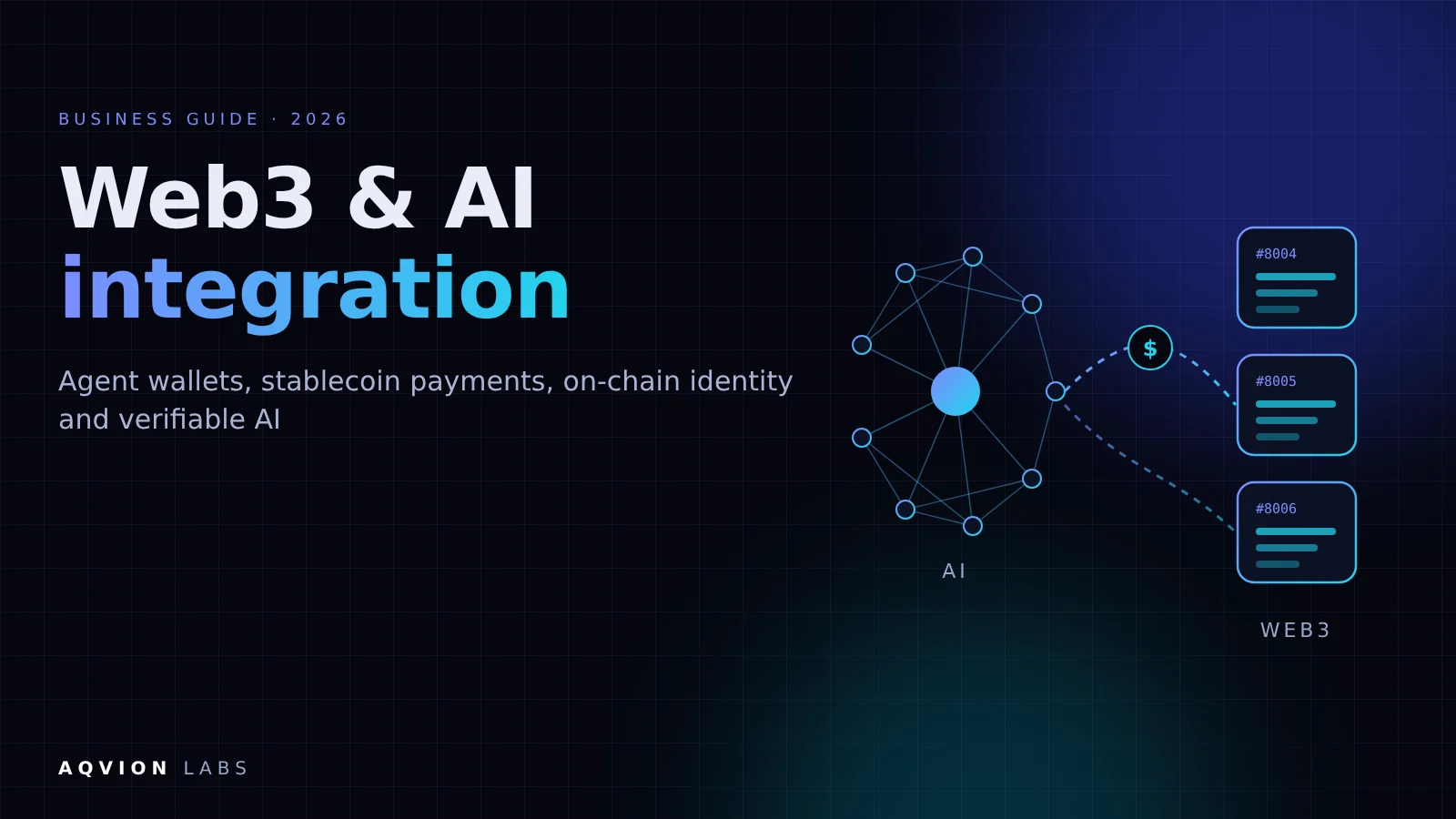
Quick answer: Web3 and AI integration means combining artificial intelligence, which decides and acts, with blockchain, which records, verifies and settles. AI agents bring automation and reasoning. Web3 gives them what they lack on their own: a wallet to pay and get paid, a verifiable identity, tamper-evident records of what they did, and rules enforced by smart contracts. In 2026 the most practical uses are agent payments with stablecoins, on-chain agent identity and reputation, verifiable AI outputs, data provenance, and AI-powered tools that make blockchain apps safer and easier to use.
Key takeaways
- AI agents are becoming economic actors. Coinbase's x402 protocol, which lets software pay for APIs with stablecoins over ordinary HTTP, has processed 165 million+ payments worth about $50 million, with around 480,000 agents counted by April 2026 (CoinDesk).
- The hype is still ahead of demand. Analysts at Artemis estimate roughly half of observed x402 transactions are gamified or test activity rather than real commerce (CoinDesk).
- Agent trust is getting a standard. ERC-8004 "Trustless Agents", a draft Ethereum standard whose authors include contributors from MetaMask, the Ethereum Foundation, Google and Coinbase, defines on-chain registries for agent identity, reputation and validation (EIP-8004).
- Verification is the real value. As AI-generated content and decisions multiply, blockchains are becoming a neutral place to prove who did what, when, and whether it was checked.
- Security decides success. An AI agent that can move money is a high-value target. Spending limits, allowlists and human approval for large actions aren't optional.
Why do AI and Web3 need each other?
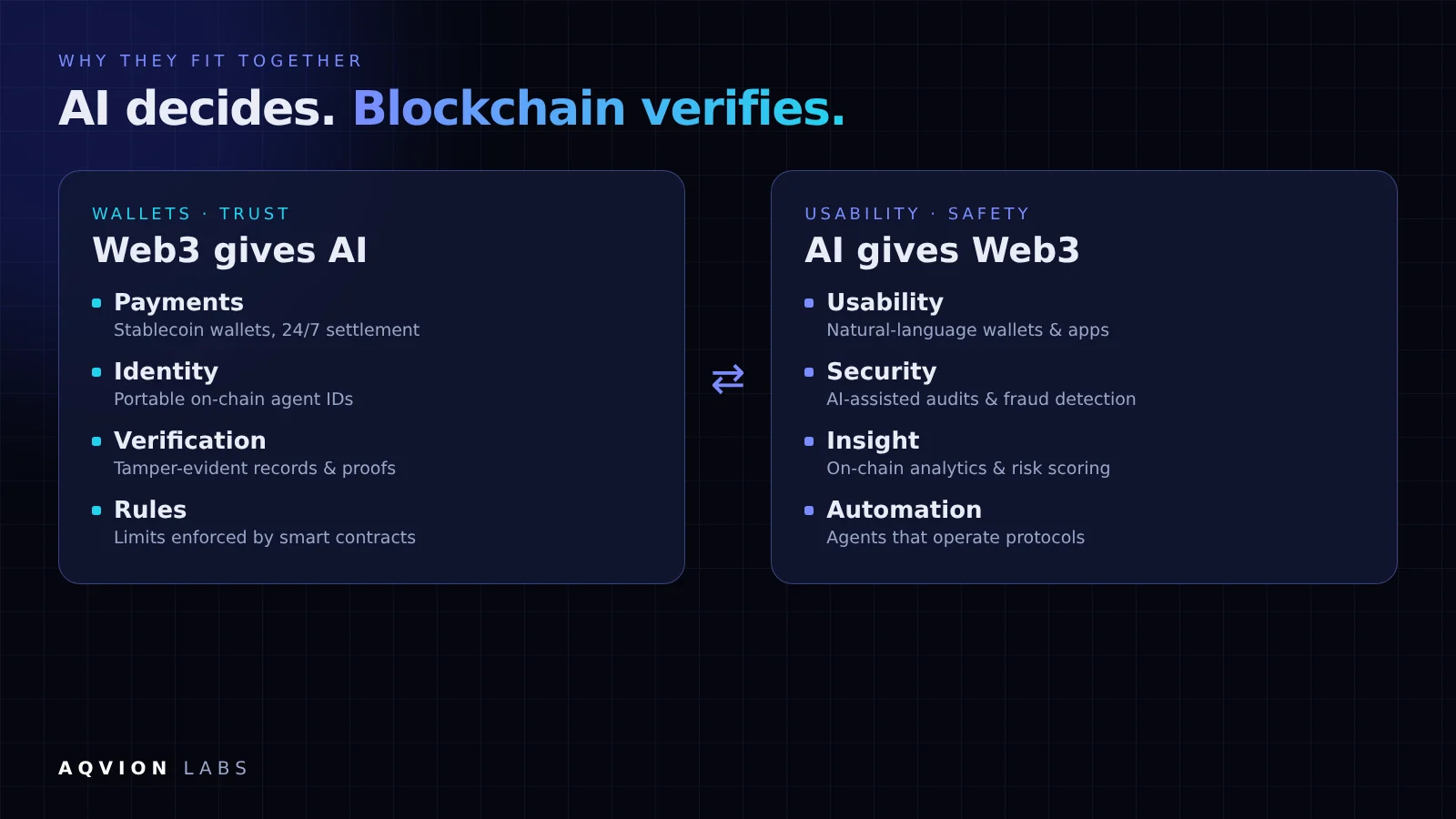
Each technology solves the other's biggest weakness:
What Web3 gives AI:
- Payments: agents can't open bank accounts, but they can use wallets and stablecoins that settle in seconds, 24/7.
- Identity: on-chain identifiers and signed actions give agents a portable way to prove who they are.
- Trust: tamper-evident records, attestations and proofs make AI outputs verifiable.
- Rules: smart contracts enforce limits in code, even if an agent misbehaves or is manipulated.
What AI gives Web3:
- Usability: natural-language interfaces hide confusing wallets, gas fees and addresses.
- Security: AI-assisted code review and fraud detection help against smart-contract bugs and scams.
- Insight: analysis, monitoring and risk scoring make huge volumes of on-chain data readable.
5 ways AI and blockchain are being integrated in 2026
1. AI agents with wallets and stablecoin payments
An agent gets its own smart wallet and pays for what it uses (APIs, data, compute, other agents' services) in stablecoins such as USDC. Protocols like x402 revive the long-unused HTTP "402 Payment Required" status code. A server answers with a price, the agent pays, and the request goes through, with no account sign-up or card required. Payments can be fractions of a cent, which card networks can't handle economically.
Business uses: pay-per-call APIs, metered data feeds, agent-to-agent marketplaces, and automated supplier payments within strict limits.
2. On-chain identity and reputation for agents
When agents transact with other agents, you need to know who you're dealing with. ERC-8004 proposes three registries:
- Identity Registry: each agent gets a portable on-chain ID that links to its description and service endpoints, including MCP and A2A endpoints.
- Reputation Registry: clients post feedback after working with an agent, optionally linked to a payment proof.
- Validation Registry: independent validators (re-runs, zkML proofs or secure hardware) confirm that an agent's work was done correctly.
3. Verifiable AI: proving what a model did
How do you prove an AI result wasn't tampered with? Three approaches are maturing:
- Zero-knowledge machine learning (zkML): a cryptographic proof that a specific model produced a specific output, without revealing the model or the data.
- Trusted execution environments (TEEs): secure hardware that signs an attestation of the exact code that ran.
- On-chain attestations: hashes of inputs, outputs and model versions anchored on a blockchain as a permanent audit trail.
These matter wherever AI decisions carry money or legal weight: credit scoring, insurance claims, compliance checks and automated trading.
4. Data and content provenance
With AI-generated text, images and video everywhere, provenance is becoming essential. Hashing and timestamping content (or its credentials) on a blockchain lets anyone check where a file came from and whether it's been altered. The same idea applies to training data: recording dataset sources and licenses helps with copyright, consent and regulatory questions about how a model was built.
5. AI that makes Web3 safer and simpler
The integration also works the other way:
- Smart-contract security: AI assistants flag likely vulnerabilities before human auditors review the code.
- Fraud and AML monitoring: models spot scams, phishing contracts and suspicious fund flows in real time.
- Natural-language wallets: "Send 50 USDC to our supplier" replaces copy-pasting long addresses, with the AI showing exactly what will be signed.
- On-chain analytics: agents summarize market, treasury and protocol risk from raw blockchain data.
What does an AI + Web3 architecture look like?
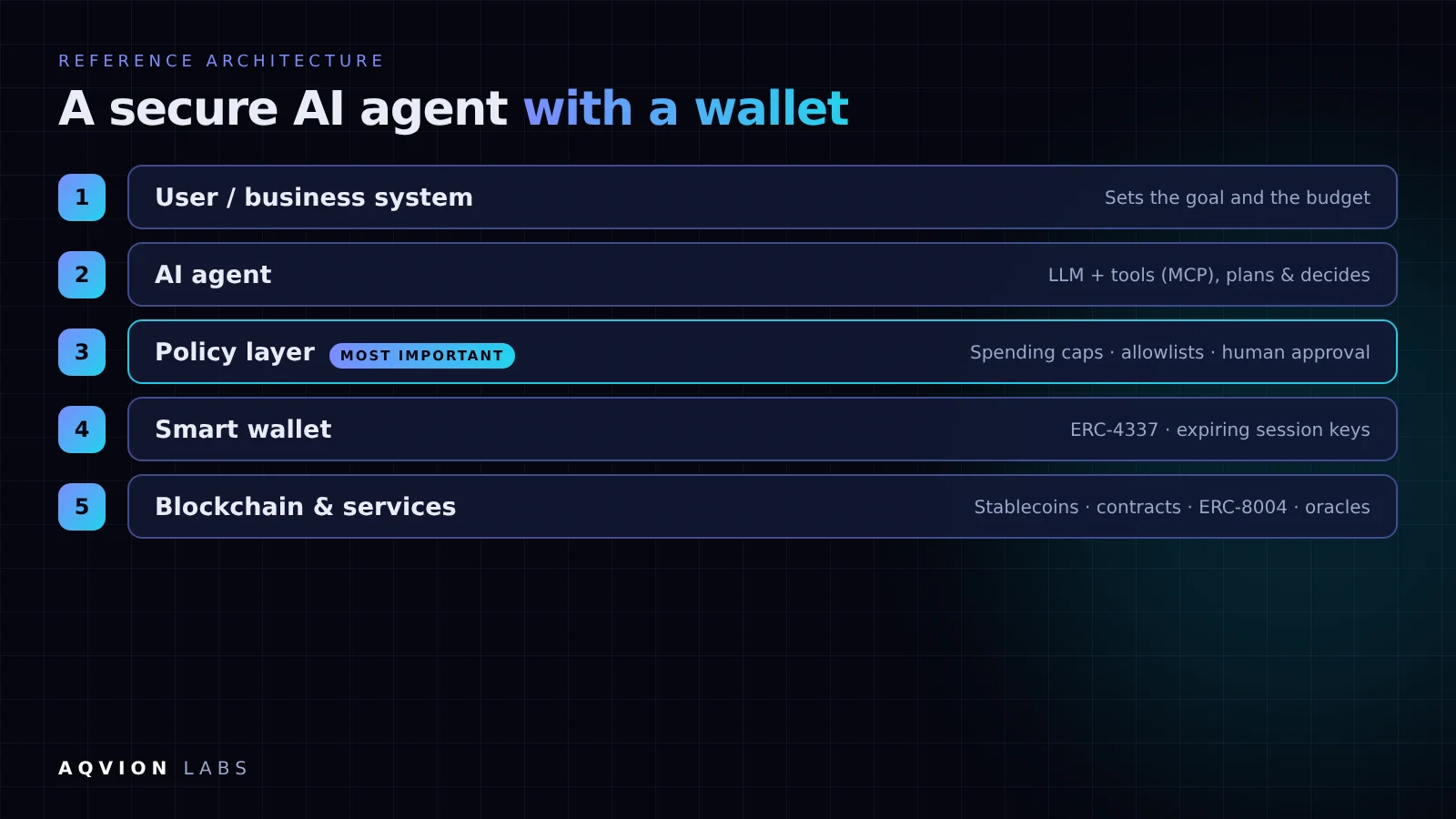
A production system usually has five layers:
- User or business system: sets the goal and the budget.
- AI agent: an LLM with tools (often connected via MCP) that plans and decides.
- Policy layer: spending limits, allowlisted contracts and counterparties, rate limits, and human approval above a threshold. This is the most important layer.
- Smart wallet: an account-abstraction wallet (ERC-4337) with session keys that expire and can't exceed the policy.
- Blockchain and services: stablecoin settlement, smart contracts, identity registries, oracles and off-chain APIs.
What are the risks of combining AI and blockchain?
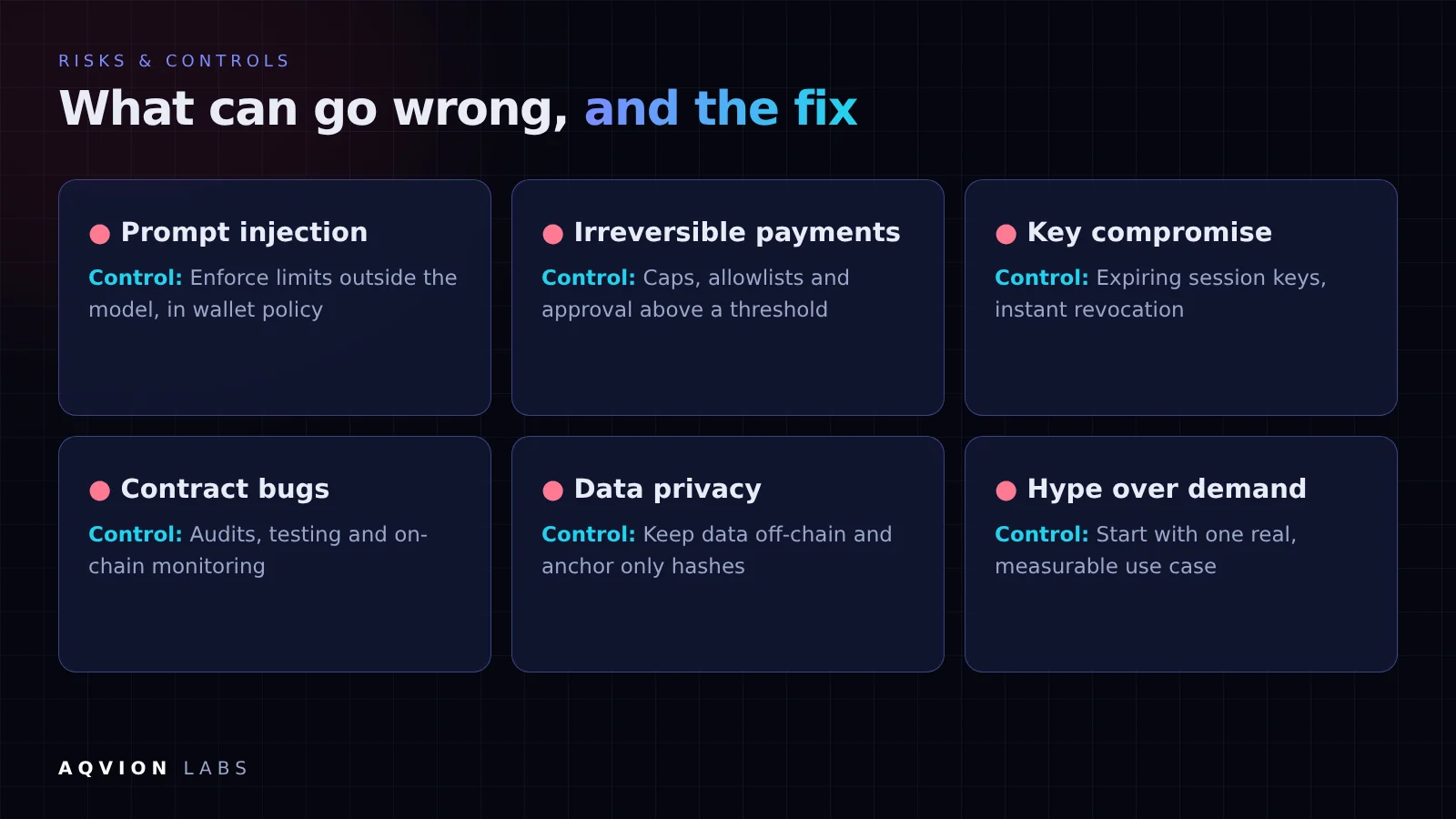
- Prompt injection meets irreversible payments. If a malicious web page or document tricks an agent, a blockchain transaction can't be charged back. Policy controls must sit outside the AI model.
- Key management. Agent keys need secure storage, short-lived permissions and the ability to revoke them instantly.
- Smart-contract bugs. Code that moves money needs audits, testing and monitoring.
- Privacy. Public blockchains are transparent. Never put personal or sensitive data on-chain; anchor only hashes or proofs.
- Hype vs reality. Much of today's agent-payment volume is experimental. Build for a real use case, not a narrative.
- Regulation. Stablecoin rules (the EU's MiCA, the US GENIUS Act), AI rules (the EU AI Act) and local financial regulations all apply. Get legal advice for your jurisdiction.
Does your business need AI + Web3 integration?
It's likely to be worth exploring if most of these are true:
- AI agents in your workflow need to pay for or sell services automatically, often in small amounts.
- Several parties need to trust or audit what an AI system did.
- You need provenance for content, data or model decisions.
- You already work with digital assets, tokenization or stablecoin settlement.
If your AI only works inside your own systems and nobody else needs to verify it, a conventional database and payment provider is usually simpler and cheaper.
How to build an AI + Web3 product safely
- Start with one narrow use case, such as an agent paying for a data API, or anchoring audit logs on-chain.
- Design the policy layer first: budgets, allowlists, approval thresholds and kill switches.
- Use smart wallets with session keys instead of giving an agent a raw private key.
- Keep sensitive data off-chain, and store only hashes, proofs and settlement on-chain.
- Red-team the agent: test prompt injection, malicious tool outputs and edge cases before real money is involved.
- Audit and monitor: review smart contracts, log every agent decision, and alert on unusual activity.
How AQVION LABS builds AI and Web3 systems
AQVION LABS brings together the three disciplines this integration needs:
- AI & intelligent systems: AI agents, LLM applications and RAG, with evaluations and human-in-the-loop controls.
- Blockchain & Web3: smart contracts, decentralized applications, tokenization and chain integration.
- Security engineering: threat modeling and security review, so that agents with wallets stay within the rules you set.
We'll also tell you when blockchain isn't needed. Plenty of AI projects are better served by a well-designed database.
Frequently asked questions
What is AI and Web3 integration?
It's the combination of AI systems, especially autonomous agents, with blockchain infrastructure such as wallets, stablecoins, smart contracts and on-chain registries. AI handles decisions and automation, while blockchain handles payments, identity, verification and enforceable rules.
Can AI agents hold crypto wallets?
Yes. Agents can control smart wallets and pay in stablecoins. Best practice is to give them limited session keys with spending caps, allowlisted destinations and human approval for larger payments, never unrestricted access to funds.
What is x402?
x402 is an open payment protocol backed by Coinbase. It uses the HTTP 402 "Payment Required" status code so that apps and AI agents can pay for APIs and content per request, typically in USDC stablecoin, without accounts or cards.
What is ERC-8004?
ERC-8004 ("Trustless Agents") is a draft Ethereum standard that defines on-chain registries for AI agent identity, reputation and validation, so that agents from different organizations can discover and trust each other.
Is it safe to let AI agents make blockchain payments?
Only with strong controls. Blockchain payments are usually irreversible, so limits, allowlists, monitoring and approval steps must be enforced outside the AI model itself, in the wallet or in smart-contract policy.
How does blockchain help with AI trust and deepfakes?
Blockchains can timestamp and anchor content credentials, model versions and output hashes, creating a tamper-evident record of where content came from and whether it has changed. That doesn't stop fakes being made, but it makes authentic content verifiable.
Build your AI + Web3 product with AQVION LABS
Exploring agent payments, verifiable AI or on-chain provenance? Start a project with us. We'll help you find the use case that pays off and build it securely.
Related reading: Blockchain & Web3 for Business: 2026 Guide · AI Agents and AGI: A 2026 Guide for Business · Why Cybersecurity Matters: 2026 Business Guide.
Sources: CoinDesk, AI agents paying with stablecoins (Aug 2026) · CoinDesk, x402 demand (Mar 2026) · ERC-8004: Trustless Agents. Figures are as reported at the time of writing and change quickly. This article is not financial or legal advice.
Author
AQVION LABS engineers intelligent systems — artificial intelligence, automation, software, data platforms and cloud infrastructure — for organizations building something serious.