AQVION LABS7 min read
Blockchain & Web3 for Business: 2026 Guide
BLOCKCHAINWEB3SMART CONTRACTSTOKENIZATIONSTABLECOINS

Quick answer: Blockchain is a shared, tamper-evident ledger that several parties can trust without a middleman. Web3 is the application layer built on top of it: wallets, smart contracts and digital assets that users own directly. In 2026, the practical business uses are stablecoin payments, tokenized real-world assets, supply-chain traceability, and verifiable digital credentials. Speculation is not the story any more.
Key takeaways
- Regulation has caught up. The EU's MiCA framework is live, and the US GENIUS Act (signed July 2025) set federal rules for payment stablecoins, with implementation due around early 2027.
- Stablecoins are now payment rails. Total stablecoin supply is above $300 billion, and businesses use stablecoins for cross-border settlement that clears in minutes, not days.
- Tokenization is going mainstream. Tokenized real-world assets passed roughly $30 billion in 2026, led by tokenized US Treasuries such as BlackRock's BUIDL fund (RWA.xyz data via Parameter).
- Most projects don't need their own chain. Mature L2 networks, audited contract libraries and wallet tooling mean you can ship faster and safer by building on existing infrastructure.
What is blockchain, in plain terms?
A blockchain is a database that many independent computers keep in sync. Records are grouped into blocks, and each block is cryptographically linked to the one before it. If anyone changes a past record, the link breaks and the network rejects the change.
That gives you three properties a normal database can't offer on its own:
- Shared truth. Several companies can rely on the same record without one of them controlling it.
- Tamper evidence. History can be added to, but it can't be quietly rewritten.
- Programmability. Smart contracts, which are small programs stored on the chain, run business rules automatically when conditions are met.
What is Web3, and how is it different from Web2?
Web3 is the set of applications and standards built on blockchains. The main difference from Web2 is who holds the keys:
- Identity: in Web2, a username and password held by the platform. In Web3, a wallet held by the user.
- Data and assets: in Web2, stored in the company's database. In Web3, recorded on a public or permissioned ledger.
- Business logic: in Web2, private server code. In Web3, open, verifiable smart contracts.
- Payments: in Web2, card networks and bank transfers. In Web3, stablecoins and on-chain settlement.
- Trust model: in Web2, you trust the platform. In Web3, you verify the code and the ledger.
In practice, the best 2026 products are hybrids. They keep a familiar Web2 interface and use blockchain only where shared trust or digital ownership adds real value.
How does a Web3 application actually work?
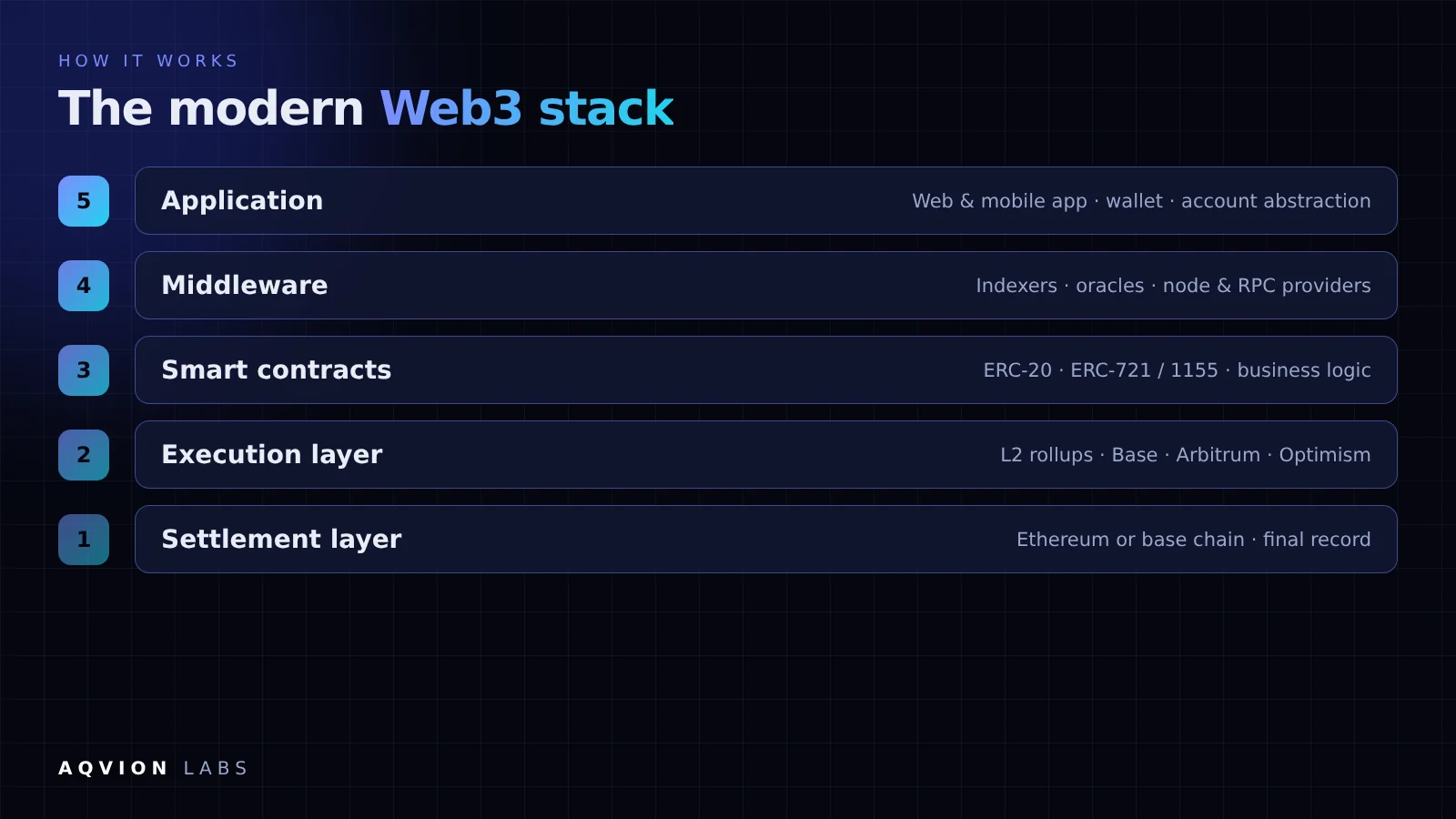
A typical production dApp has five layers:
- Settlement layer: a base chain such as Ethereum, where the final record lives.
- Execution layer: a Layer 2 rollup (for example Base, Arbitrum or Optimism) or a high-throughput chain that processes transactions cheaply and fast.
- Smart contracts: the business rules, ideally built from audited standards such as ERC-20 for tokens and ERC-721 or ERC-1155 for NFTs.
- Middleware: indexers, oracles that bring off-chain data on-chain, and node providers.
- Application layer: your web or mobile app, plus a wallet. With account abstraction (ERC-4337), that wallet can feel like a normal login and even sponsor gas fees for users.
What are the real business use cases for blockchain in 2026?
1. Stablecoin payments and treasury
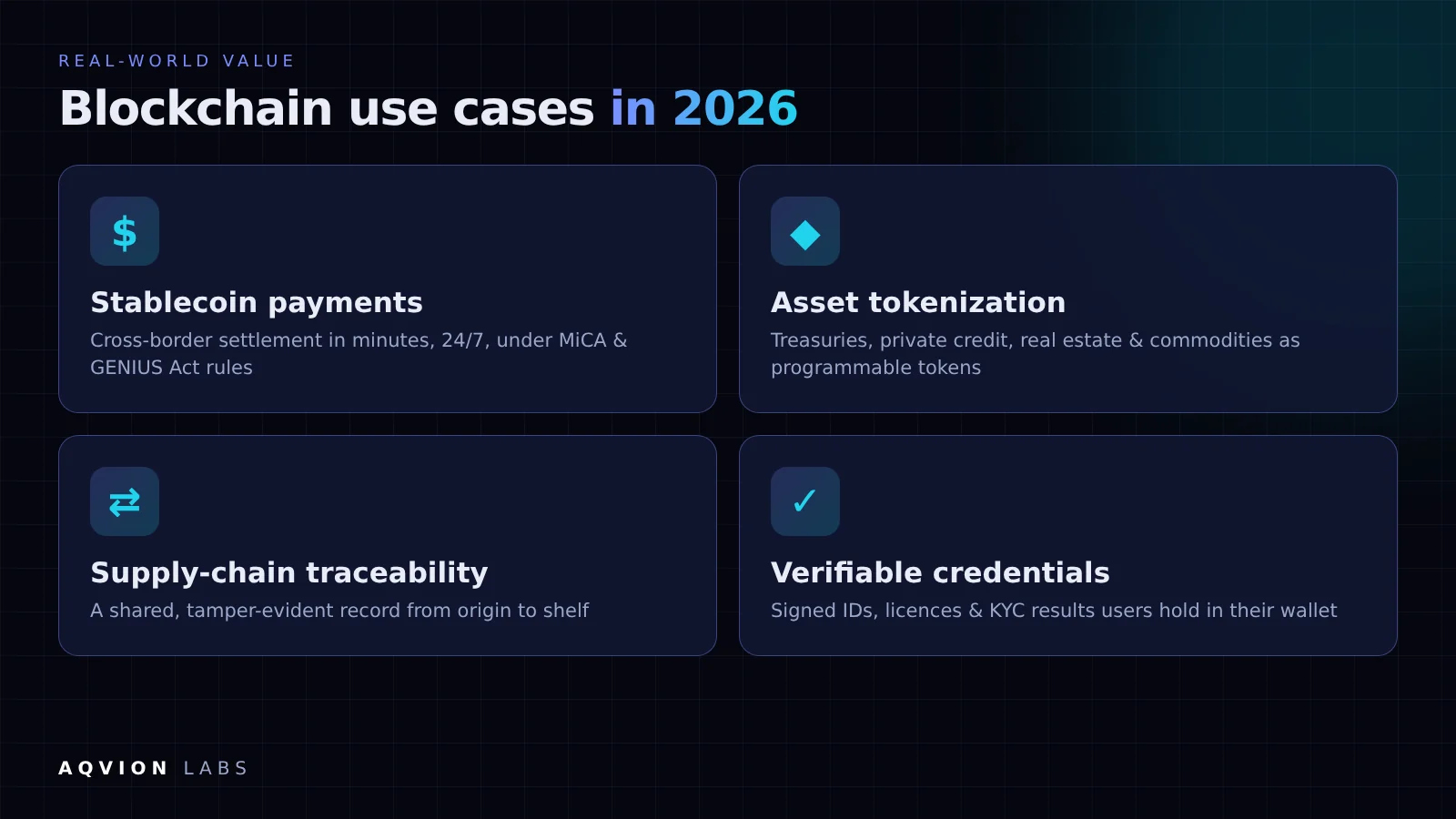
Stablecoins are tokens pegged 1:1 to a currency such as the US dollar. For businesses that pay suppliers or contractors across borders, they replace multi-day wires with settlement in minutes, at any hour. Under MiCA and the GENIUS Act, regulated issuers must hold full reserves and honor redemption at par (BVNK overview). That clarity is what finance teams were waiting for.
2. Tokenization of real-world assets (RWA)
Tokenization represents ownership of an asset (Treasuries, private credit, real estate, commodities, invoices) as a token on a blockchain. The benefits are fractional ownership, faster settlement, 24/7 transferability and transfer rules written into the code itself, such as allowing only verified investors to hold the token.
3. Supply-chain traceability
When a manufacturer, shipper and retailer write to the same ledger, each product's history becomes verifiable end to end. This is useful for proving origin, for compliance audits, and for fighting counterfeits in sectors like food, pharma and luxury goods.
4. Digital identity and verifiable credentials
Certificates, licenses and KYC results can be issued as cryptographically signed credentials that a user holds in their wallet. A verifier can check them instantly without calling the issuer, and the user shares only what's needed.
Do you need a blockchain? A simple test
Blockchain adds cost and complexity, so use it only when the answer to most of these questions is yes:
- Do several organizations need to write to and trust the same data?
- Is there no single party everyone is willing to trust as the operator?
- Does a tamper-evident audit trail matter (for regulators, partners or customers)?
- Do you need to move or prove ownership of digital value?
- Would automated, verifiable rules (smart contracts) remove manual reconciliation?
If only one company writes the data and everyone already trusts it, a well-designed conventional database is usually the better choice. We'll tell clients that directly.
How to build a blockchain project without the common mistakes
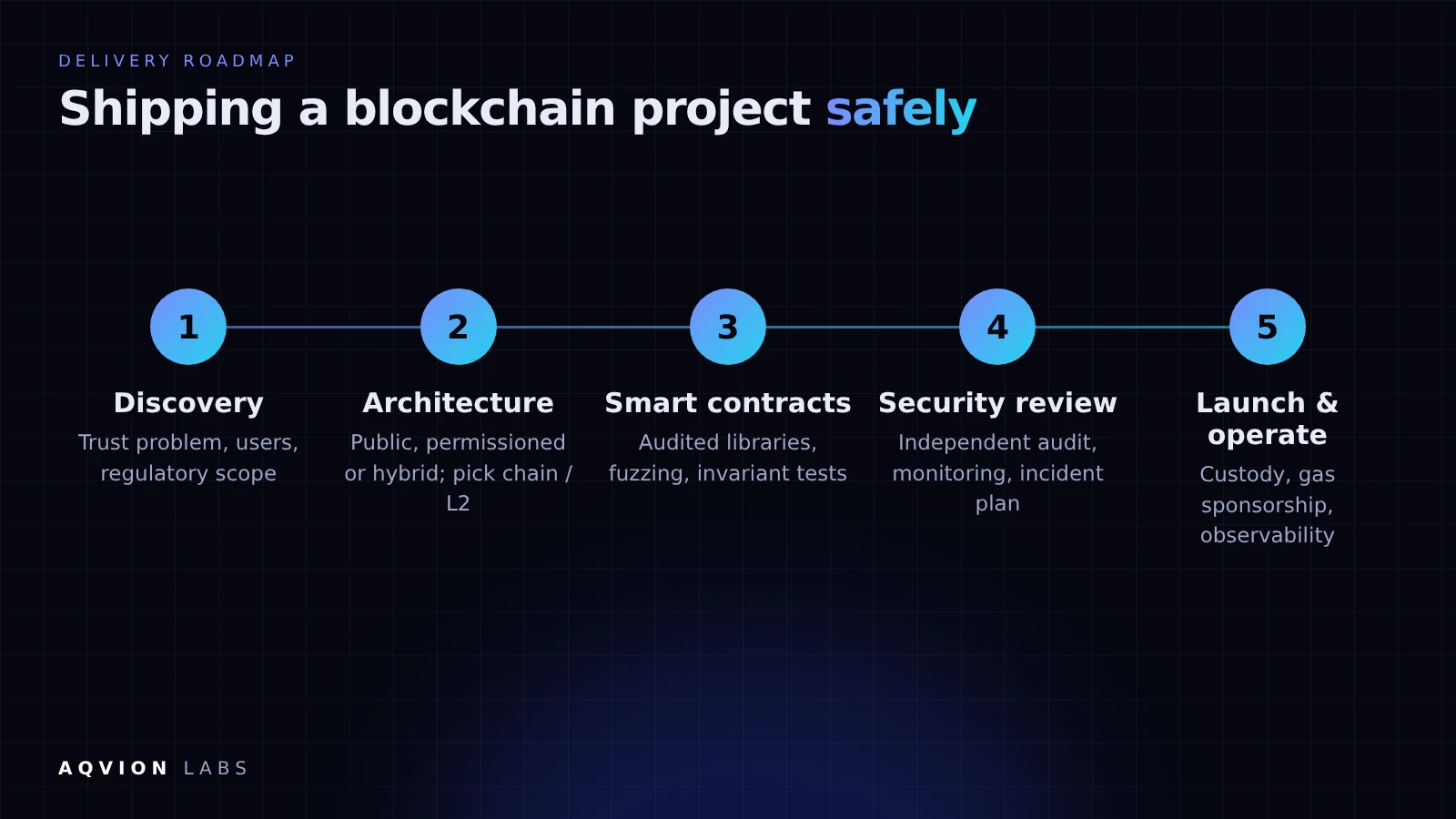
- Discovery. Define the trust problem, the users and the regulatory scope (MiCA, GENIUS Act, local securities and AML rules).
- Architecture. Choose public, permissioned or hybrid. Pick a chain or L2 based on fees, ecosystem, compliance tooling and where your users already are.
- Smart-contract engineering. Start from audited libraries, keep contracts small and upgradeable only where necessary, and test with fuzzing and invariant checks.
- Security review. Get an independent audit, add monitoring and a pause or incident plan before launch. Most on-chain losses come from contract bugs, leaked keys and phishing, not from the chain itself.
- Launch and operate. Use custody that fits (MPC or multisig), gas sponsorship for smooth onboarding, and observability across both the on-chain and off-chain parts of the system.
Blockchain and Web3 trends to watch
- Stablecoins built into mainstream payment providers and banking apps, as regulated issuers scale up.
- Tokenized funds used as collateral in both traditional and on-chain markets.
- AI agents with wallets, paying for APIs and services autonomously with stablecoins.
- Zero-knowledge proofs that prove facts (age, solvency, compliance) without revealing the underlying data.
- Chain abstraction, where users stop noticing which network they're on.
Frequently asked questions
Is blockchain the same as cryptocurrency?
No. Cryptocurrency is one application of blockchain. The same technology also powers stablecoin payments, tokenized assets, supply-chain records and digital credentials.
Is Web3 still relevant in 2026?
Yes, though the focus has moved from hype to utility. Regulated stablecoins, tokenized Treasuries and enterprise traceability are growing because they solve real settlement and trust problems.
What does it cost to build a blockchain application?
It depends on scope. A focused proof of concept with a few audited smart contracts and a web app is far cheaper than a full tokenization platform with compliance, custody and integrations. The independent security audit is a cost to budget for from day one.
Which blockchain should my business use?
For most public-facing products, an Ethereum Layer 2 gives low fees, strong security and a large developer ecosystem. Consortium use cases may suit a permissioned network. The right answer depends on your users, regulators and integration needs.
Are smart contracts legally binding?
A smart contract is code that executes automatically. It isn't a legal contract on its own. Many businesses pair on-chain logic with conventional legal agreements, so get legal advice for your jurisdiction.
How secure is blockchain?
Mature blockchains themselves are very hard to attack. The risk sits in the application layer: smart-contract bugs, poor key management and social engineering. Audits, battle-tested libraries and strong custody address most of it.
Build with AQVION LABS
AQVION LABS designs and engineers blockchain and Web3 systems: smart contracts, decentralized applications, tokenization platforms and integrations with existing software. Every build includes security engineering from the first commit.
Not sure whether blockchain fits your use case? Start a project with us and we'll give you a straight answer, even if it's "use a database".
Sources: Parameter / RWA.xyz on RWA tokenization · BVNK, Global stablecoin regulations 2026 · Finextra, Enterprise tokenization platforms in 2026. Figures are as reported at the time of writing and change quickly.
Author
AQVION LABS
AQVION LABS engineers intelligent systems — artificial intelligence, automation, software, data platforms and cloud infrastructure — for organizations building something serious.