AQVION LABS9 min read
Developer Supply-Chain Attacks: A 2026 Guide for Business
SUPPLY CHAIN SECURITYCYBERSECURITYDEVSECOPSNPMAI TOOLS
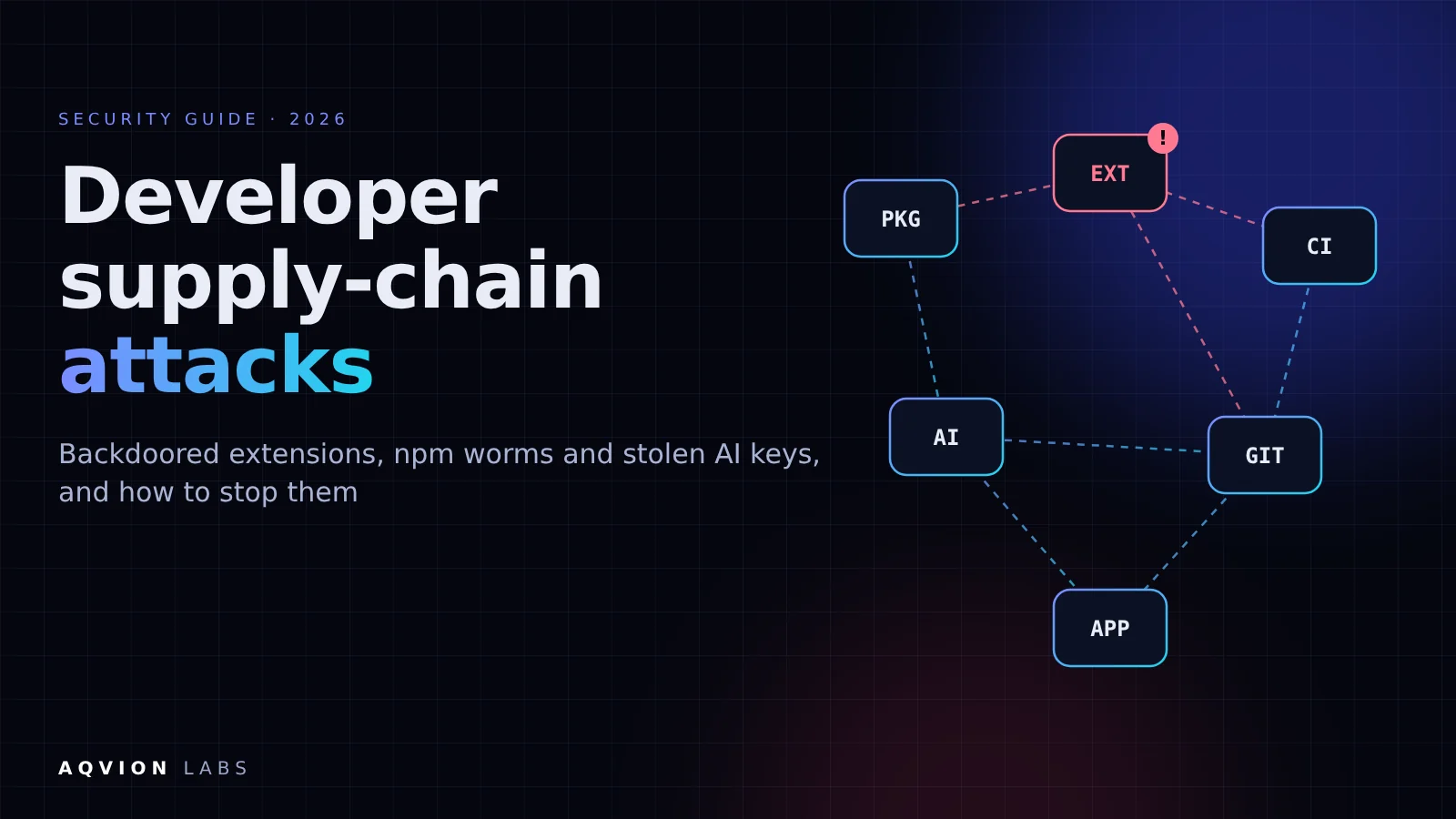
Quick answer: A software supply-chain attack compromises something developers trust, such as a code editor extension, an open-source package or a build pipeline, so that malware reaches every machine and product that uses it. In 2026 these attacks have shifted to target developers and their AI tools directly. They steal cloud keys, GitHub and npm tokens and AI API keys from laptops and pipelines, then spread on their own. Most businesses can cut the risk sharply with pinned dependencies, a delay before adopting new versions, short-lived tokens, approved extension lists and isolated build systems.
Key takeaways
- A trusted AI coding extension was backdoored. On October 29, 2026, malicious versions of the Claude Code extension (2.1.312 and 2.1.313) appeared in Cursor's extension marketplace for about 11 hours. They collected system details, added an attacker SSH key and set up persistence on Windows and macOS (Cursor security notice).
- Worms now spread through npm. The "Shai-Hulud" CHAINDROP campaign compromised 400+ npm packages with over 1.3 billion monthly downloads in August 2026. It scanned for more than 300 types of secrets, including AI tool keys, cloud credentials and GitHub tokens, then republished itself using stolen tokens (Elastic Security Labs).
- Extension marketplaces are a target. The GlassWorm campaign pushed at least 72 malicious extensions to the Open VSX registry from January 2026. It hid code with invisible Unicode characters and used "harmless" extensions that later pull in malicious ones (The Hacker News).
- Third parties are now a major breach path. Verizon's 2025 Data Breach Investigations Report found third-party involvement in breaches doubled to 30%.
- Uninstalling isn't enough. These attacks often leave persistence and stolen credentials behind, so response means cleaning machines and rotating secrets.
What is a software supply-chain attack?
Modern software is assembled, not written from scratch. A typical web app pulls in hundreds or thousands of open-source packages. Developers use editors with dozens of extensions, AI coding assistants and build pipelines that run code automatically.
A supply-chain attack compromises one of those trusted links instead of attacking your systems head-on. Because developers and pipelines automatically trust and run that code, the attacker gets inside without breaking anything. They just wait to be installed.
Why are developers the new target?
- Developer machines hold the keys. Laptops often contain cloud credentials, SSH keys, GitHub and npm tokens, database passwords and now AI API keys, all in one place.
- Extensions run with full access. Editor extensions can usually read files, run commands and reach the network with the same rights as the developer.
- AI tools widen access. Coding agents and their integrations can read repositories, run terminals and call external tools, so a compromised AI tool is very powerful.
- Pipelines publish automatically. One stolen publishing token can push malicious updates to thousands of downstream users within minutes.
- It scales. Compromise one popular package or extension and you reach every company that installs it.
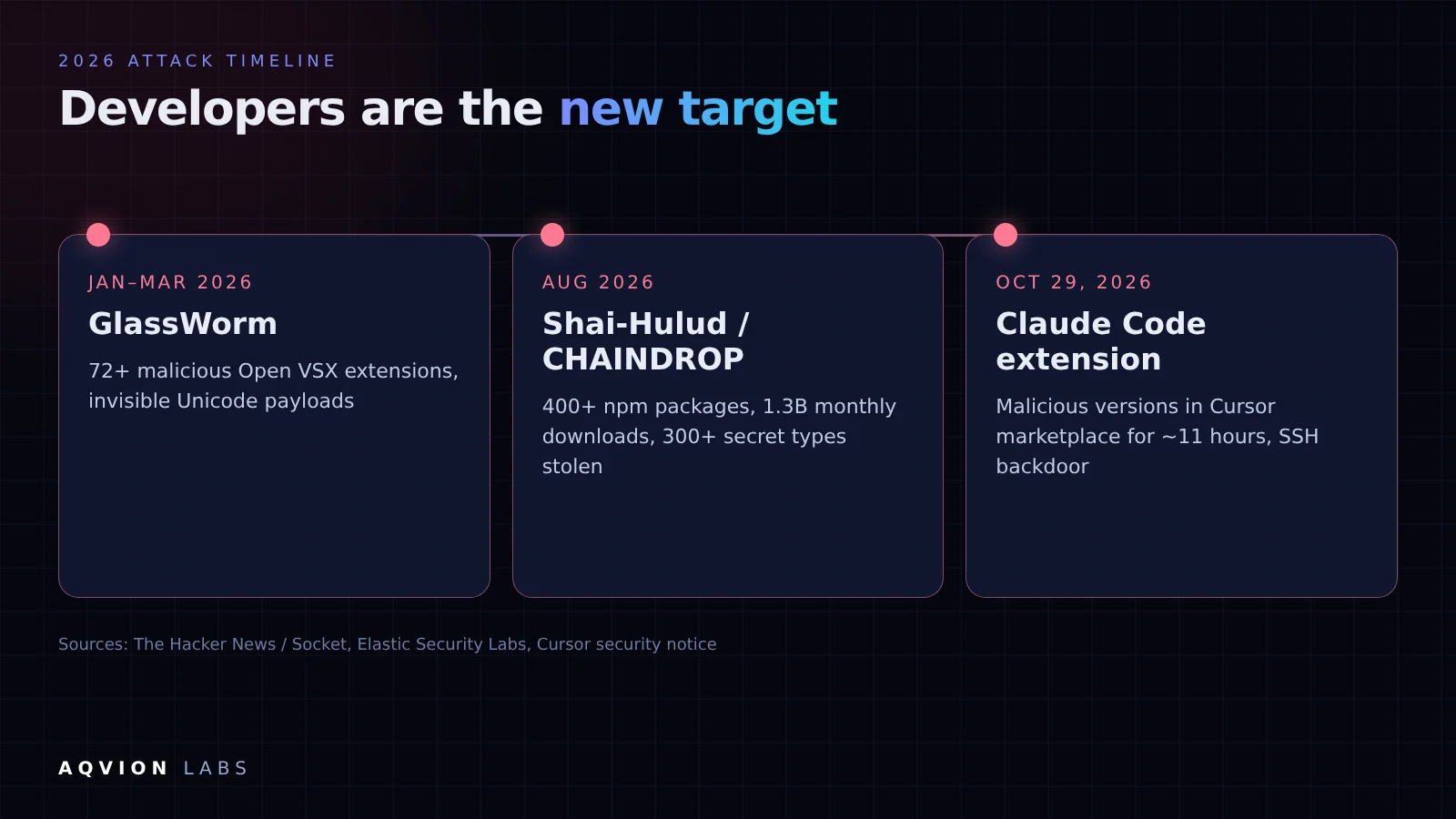
Three 2026 attacks every team should know
1. The backdoored Claude Code extension (October 2026)
Cursor reported that two versions of the Claude Code extension in its marketplace weren't built by Anthropic. During the roughly 11 hours they were live, they:
- sent host details (hostname, username, OS, Git email and public IP) to the attacker;
- added an SSH key labeled
svc-telemetryto the user's authorized keys; - tried to open a reverse SSH tunnel, and set up persistence through a macOS LaunchAgent or a Windows scheduled task.
Cursor removed the versions, rebuilt the marketplace and rotated keys. It warned that uninstalling the extension alone may leave persistence running, and recommended removing the key and persistence and rotating credentials.
2. Shai-Hulud / CHAINDROP npm worm (August 2026)
Starting from a compromised maintainer, malicious versions of 400+ npm packages ran a preinstall script during installation. The payload searched for secrets (cloud, GitHub, npm, Kubernetes, Vault and AI tooling keys), exfiltrated them, and republished itself to every package a stolen token could publish. It also committed malicious hooks to repositories it could reach.
3. GlassWorm extension campaign (2026)
GlassWorm targeted the Open VSX registry used by many VS Code-compatible editors. Its tricks included invisible Unicode characters that hide code from reviewers, and harmless-looking extensions that later install a malicious dependency in an update. The goal was stealing tokens and credentials and draining crypto wallets.
How do supply-chain attacks get in?
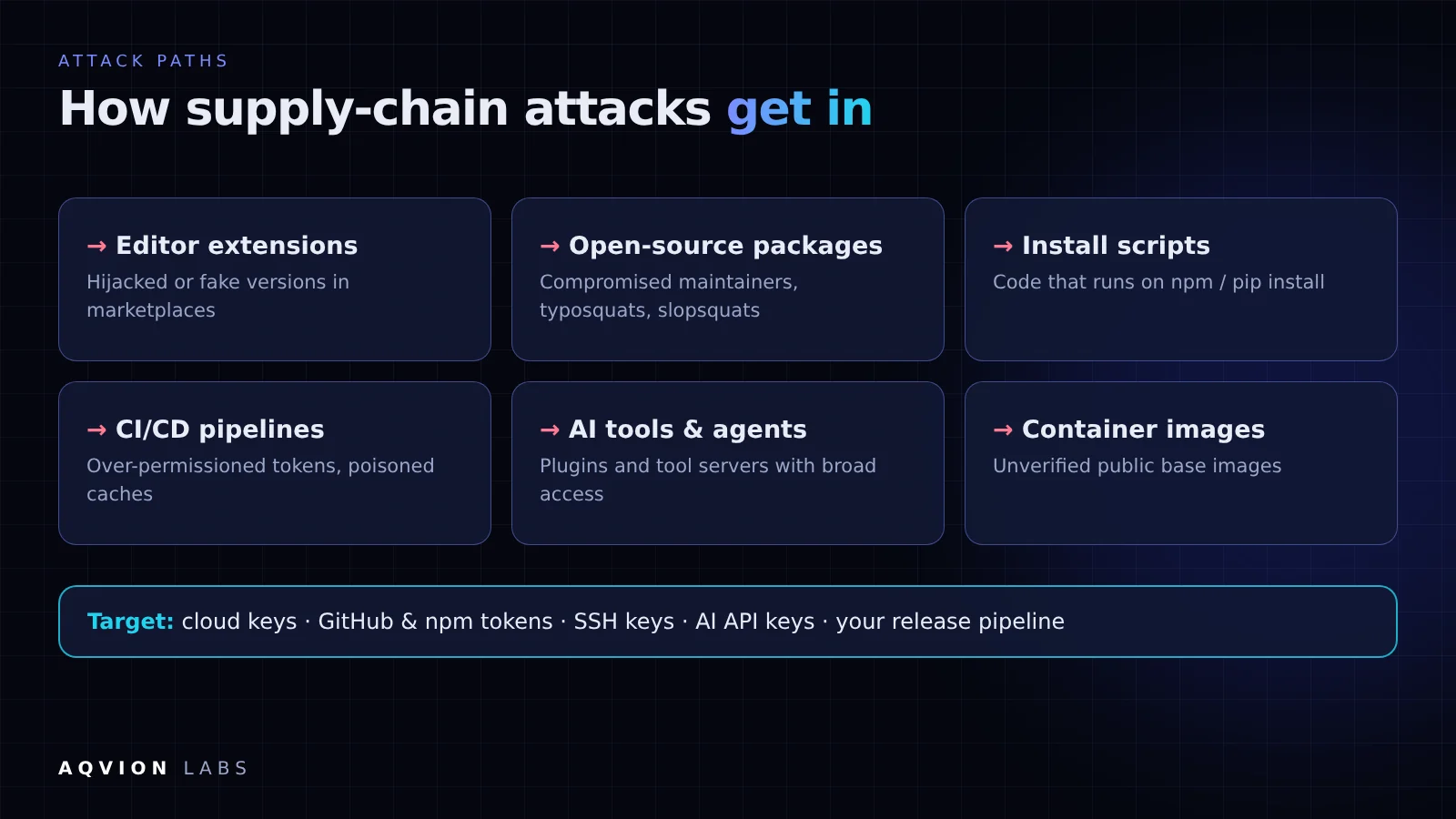
- Editor extensions and plugins: malicious or hijacked versions in marketplaces.
- Open-source packages: compromised maintainers, typosquatting, and packages that AI tools "hallucinate", which attackers then register (slopsquatting).
- Install scripts: code that runs automatically when a package is installed.
- CI/CD pipelines: over-permissioned tokens, untrusted pull requests and poisoned build caches.
- AI tools and integrations: extensions, agent plugins and tool servers with broad access to code and terminals.
- Container images: unverified base images pulled from public registries.
What does a supply-chain attack cost a business?
- Stolen credentials open your cloud, code and customer data to attackers, often weeks after the initial infection.
- Poisoned products: if your release pipeline is hit, you could ship malware to your own customers.
- Incident response means cleaning developer machines, rotating every exposed secret and auditing repositories.
- Loss of trust with clients who now ask how you secure your software supply chain.
How to protect your business from supply-chain attacks
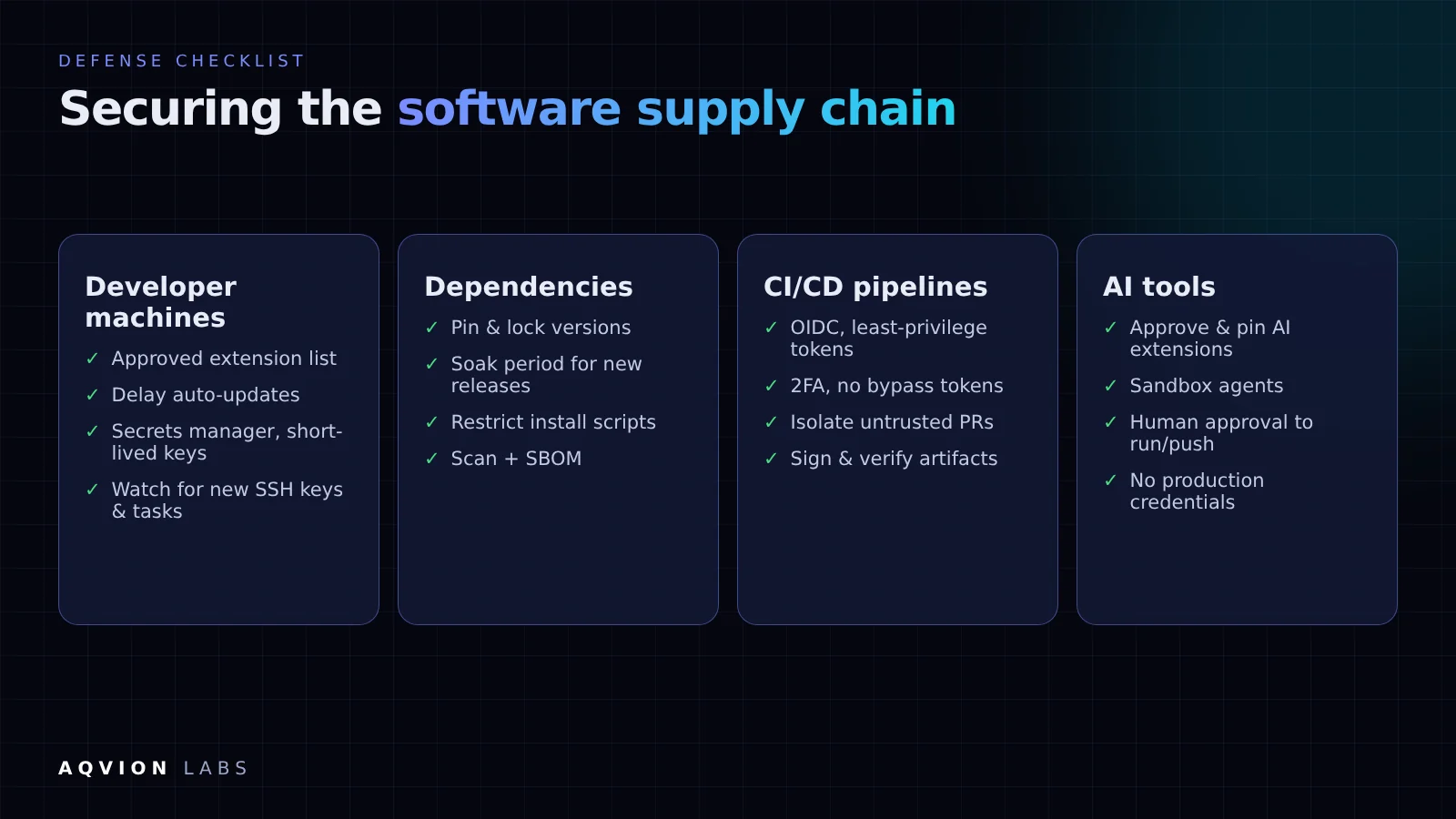
Developer machines
- Use an approved extension list. Install only from verified publishers, and review permissions.
- Turn off automatic extension updates for critical tools, or delay them, so you aren't the first to get a bad release.
- Keep secrets out of plain files. Use a secrets manager and short-lived credentials instead of long-lived keys in
.envfiles or shell profiles. - Run endpoint protection that watches for new SSH keys, scheduled tasks and launch agents.
Dependencies
- Pin and lock versions with lockfiles, and review changes to them in pull requests.
- Add a "soak" period. Don't adopt brand-new package versions for a few days, when most malicious releases are caught.
- Disable or restrict install scripts where your package manager allows it.
- Scan dependencies for known vulnerabilities and malicious packages on every pull request.
- Generate an SBOM (software bill of materials) so you can quickly answer "are we affected?".
CI/CD pipelines
- Use short-lived, least-privilege tokens. Prefer OIDC federation over stored cloud keys.
- Require 2FA on registry and Git accounts, and avoid tokens that bypass it.
- Isolate builds from untrusted pull requests, and protect release branches.
- Sign and verify artifacts, for example with provenance attestations, before deploying.
AI tools
- Treat AI extensions and agent plugins like any other dependency: approve, pin and monitor them.
- Limit what agents can do. Use sandboxes, least-privilege tokens, and human approval before running commands or pushing code.
- Never give AI tools broad production credentials.
What to do if you think you're affected
- Isolate affected machines from the network.
- Remove the malicious package or extension, and any persistence it created: SSH keys, scheduled tasks, launch agents and startup scripts.
- Rotate every secret the machine or pipeline could access, from a clean device: cloud, Git, registry, database and AI keys.
- Audit repositories and pipelines for unexpected commits, workflow changes or new tokens.
- Rebuild compromised hosts if you can't be sure they're clean.
How AQVION LABS helps secure your software supply chain
AQVION LABS builds and secures software with the supply chain in mind, through security engineering, cloud and infrastructure and managed services:
- Supply-chain review: dependencies, lockfiles, extensions, CI/CD permissions and secret handling, reported with concrete fixes.
- Hardened pipelines: short-lived credentials, protected branches, dependency scanning, SBOMs and signed builds.
- Secure AI-assisted development: guardrails for coding agents and AI tools, as described in our AI coding guide.
- Incident support: help with cleaning up, rotating secrets and auditing after a suspected compromise.
Frequently asked questions
What is a software supply-chain attack?
It's an attack that compromises a trusted component of software development, such as an open-source package, editor extension, build tool or update server, so malicious code reaches everyone who uses it.
Are VS Code and Cursor extensions safe?
Most are, but extensions run with broad access to your files and system, and marketplaces have been abused in 2026. Use verified publishers, keep an approved list, review permissions and avoid instantly auto-updating critical extensions.
What was the Shai-Hulud npm worm?
It's a self-spreading npm supply-chain campaign that compromises packages, steals developer secrets during installation and uses stolen publishing tokens to infect more packages. A large wave in August 2026 hit more than 400 packages.
Is uninstalling a malicious extension enough?
Often not. Recent malware created persistence (scheduled tasks, launch agents, SSH keys) and stole credentials. You need to remove persistence, rotate secrets and check for unauthorized access.
What is an SBOM and why does it help?
A software bill of materials is an inventory of every component in your software. When a new attack is announced, it lets you check within minutes whether you're affected.
How can a small team start?
Enable 2FA everywhere, use lockfiles and dependency scanning, delay adopting brand-new package versions, keep an approved extension list, and replace long-lived keys with short-lived credentials.
Get a supply-chain security review
Not sure what's running on your developers' machines or inside your build pipeline? Talk to AQVION LABS about a supply-chain security review and a practical hardening plan.
Related reading: Autonomous Exposure Remediation: A 2027 Guide for Business · AI Coding Agents and Vibe Coding: A 2026 Guide for Business · Why Cybersecurity Matters: 2026 Business Guide.
Sources: Cursor, security notice on malicious Claude Code extension versions · Elastic Security Labs, Shai-Hulud CHAINDROP npm worm · The Hacker News, GlassWorm abuses 72 Open VSX extensions · Verizon 2025 Data Breach Investigations Report. Details are as reported at the time of writing.
Author
AQVION LABS engineers intelligent systems — artificial intelligence, automation, software, data platforms and cloud infrastructure — for organizations building something serious.