AQVION LABS8 min read
Why Cybersecurity Matters: 2026 Business Guide
CYBERSECURITYSECURITY ENGINEERINGDATA BREACHRANSOMWAREAI SECURITY
Quick answer: Cybersecurity is the set of practices, technologies and habits that keep your systems, data and customers safe from attack. It matters because a single breach now costs a business USD 4.44 million on average, and the most common attacks (stolen credentials, ransomware, unpatched software and compromised suppliers) mostly exploit basics that were never put in place. Strong security isn't a product you buy at the end. It's built into how software is designed, written and run.
Key takeaways
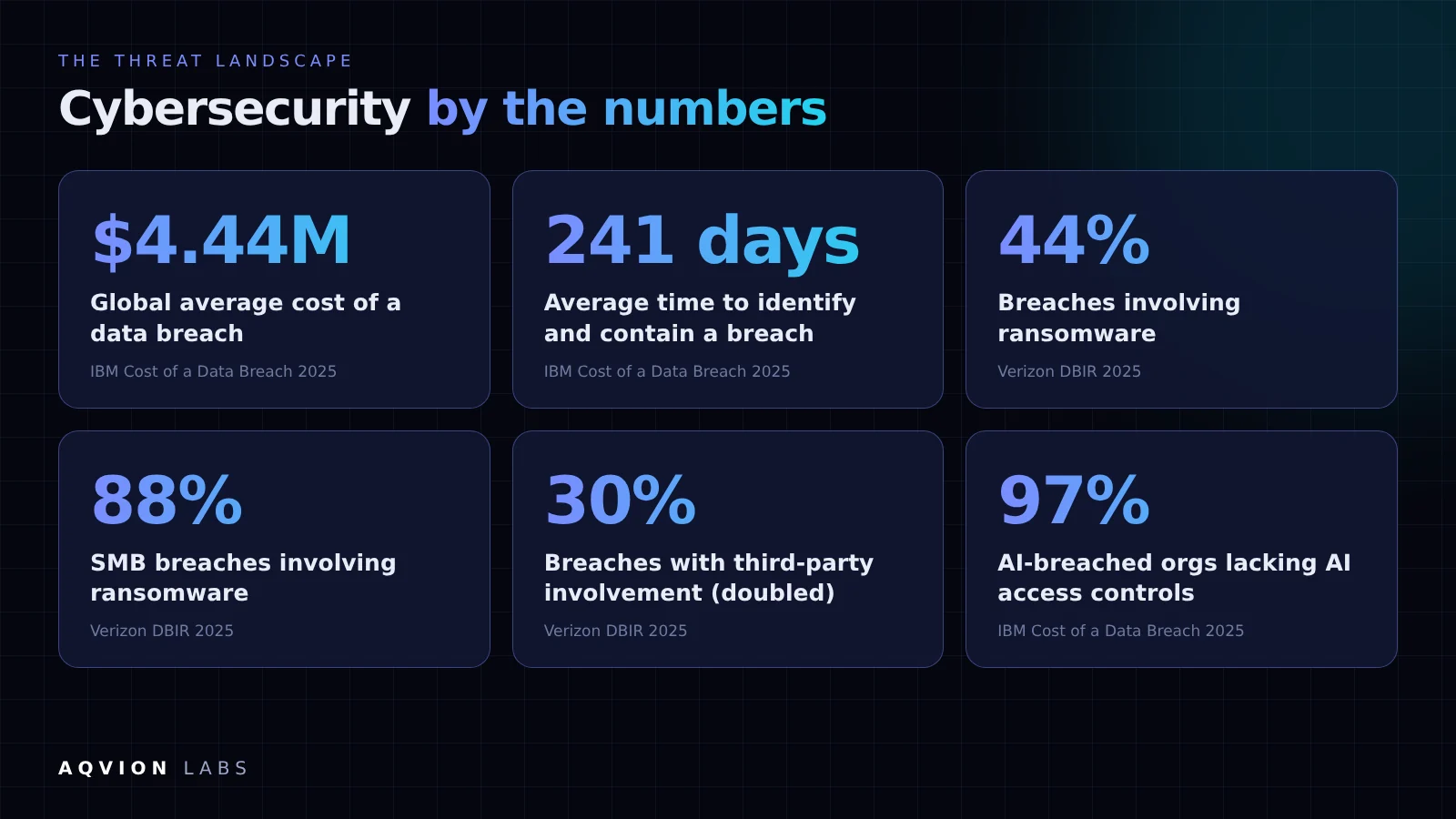
- Breaches are expensive. IBM's 2025 Cost of a Data Breach report puts the global average at USD 4.44 million, and it still takes organizations 241 days on average to identify and contain a breach (IBM).
- Ransomware hits small businesses hardest. Verizon's 2025 Data Breach Investigations Report found ransomware in 44% of the breaches it reviewed, and in 88% of breaches at small and mid-sized businesses (Verizon DBIR 2025).
- Your suppliers are your attack surface. Third-party involvement in breaches doubled to 30%.
- AI adds new risk. 13% of organizations reported breaches involving AI models or apps, and 97% of those lacked proper AI access controls.
- Most damage is preventable. Phishing-resistant MFA, fast patching, tested backups, least-privilege access and secure development stop the majority of real-world attacks.
What is cybersecurity, and why does it matter for business?
Cybersecurity protects three things, often called the CIA triad:
- Confidentiality. Only the right people can see data: customer records, payment details, source code, contracts.
- Integrity. Data and systems aren't changed without authorization: orders, invoices, balances, configurations.
- Availability. Systems stay up when customers and staff need them.
For a modern business, almost every process (sales, payments, payroll, support, delivery) runs on software. That makes security a business continuity issue, not just an IT one. If attackers can stop your systems or steal your data, they can stop your business.
What are the biggest cybersecurity threats in 2026?
1. Ransomware and extortion
Attackers encrypt or steal data, then demand payment. Verizon found ransomware rose 37% year on year. The median ransom paid was about USD 115,000, and 64% of victims refused to pay. That's a sign that good backups and response plans work.
2. Stolen credentials and phishing
Credential abuse was the leading way in (22%) of breaches. Passwords are phished, reused or bought from earlier leaks, and then attackers simply log in. AI now makes phishing emails, fake invoices and even voice or video deepfakes far more convincing.
3. Exploited vulnerabilities
Exploiting software flaws was the first step in 20% of breaches, up 34%. Internet-facing systems such as VPNs, firewalls and other edge devices are prime targets, often attacked within days of a patch being released.
4. Supply-chain and third-party risk
A breach at a vendor, SaaS tool, plugin or software library can become your breach. With third-party involvement at 30%, vendor access and open-source dependencies need the same care as your own code.
5. Cloud misconfiguration and exposed secrets
Public storage buckets, over-permissive roles and API keys committed to code repositories remain some of the easiest wins for attackers.
6. AI-specific risks
New AI features bring new attack types: prompt injection (malicious instructions hidden in content an AI reads), data leakage through AI tools, and shadow AI, where staff use unapproved AI services with company data. IBM found high levels of shadow AI added about USD 670,000 to the average breach cost.
What happens if cybersecurity isn't implemented properly?
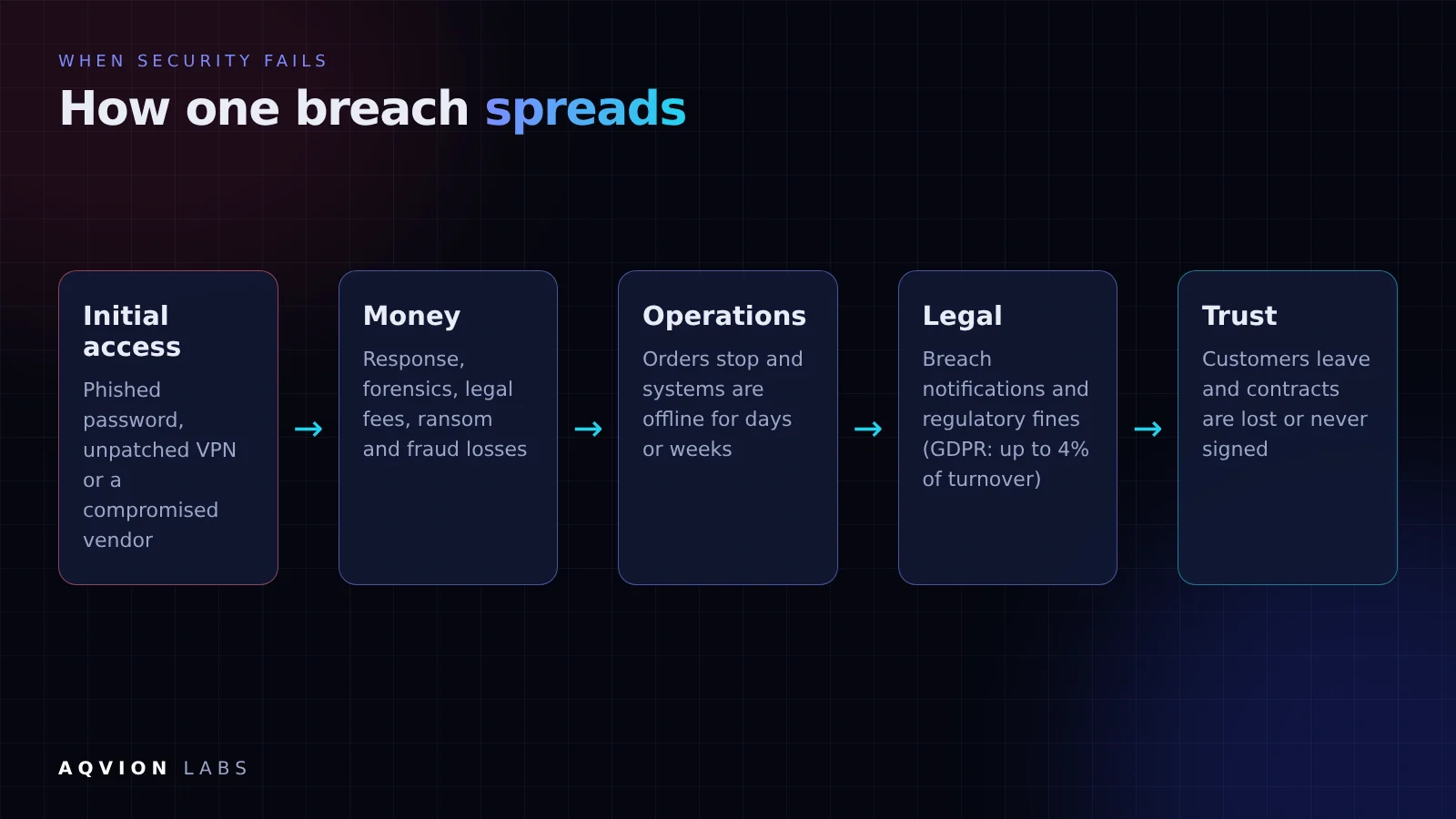
Weak security rarely fails quietly. The impact stacks up across the business:
- Direct financial loss: incident response, forensic investigation, legal fees, system rebuilds, ransom demands and fraud losses.
- Downtime: orders stop, staff can't work and deliveries slip, sometimes for weeks while systems are restored.
- Regulatory penalties: data protection laws such as the EU's GDPR allow fines of up to €20 million or 4% of global annual turnover, whichever is higher, plus mandatory breach notifications.
- Lost trust and revenue: customers leave, and larger clients increasingly require security evidence before they sign or renew contracts.
- Long recovery: with breaches taking about eight months on average to identify and contain, attackers often have a long time inside before anyone notices.
- Hidden costs: higher cyber-insurance premiums, delayed product launches and leadership time spent firefighting instead of growing.
For small and mid-sized companies, one serious ransomware incident can be an existential event.
Essential cybersecurity controls every business needs
You don't need an enterprise budget to stop most attacks. Start with these:
- Phishing-resistant multi-factor authentication (MFA) on email, cloud, admin panels and VPNs. Passkeys or hardware keys are best.
- Patch fast, especially internet-facing systems, and keep an inventory of what you run.
- Backups you've actually restored: follow the 3-2-1 rule (three copies, on two kinds of media, one off-site), with at least one copy that can't be altered.
- Least-privilege access: everyone gets only the permissions they need, and admin rights are rare and logged.
- Secrets management: no passwords or API keys in code, chat or spreadsheets. Use a vault and rotate keys.
- Logging and monitoring: centralize logs and alert on suspicious sign-ins, privilege changes and data exports.
- Vendor and dependency checks: review third-party access and scan open-source libraries for known vulnerabilities.
- Security awareness: short, regular training on phishing, payment-change fraud and safe AI use.
- An incident response plan: who does what, who to call, and how to communicate, rehearsed before you need it.
- AI governance: an approved list of AI tools, rules about what data can go into them, and access controls on any AI features you build.
What is secure-by-design software development?
Many breaches start in the application itself: broken access control, injection flaws, weak authentication or leaked secrets. These are the issues catalogued in the OWASP Top 10. Secure-by-design means building protection in from the first line of code instead of bolting it on before launch:
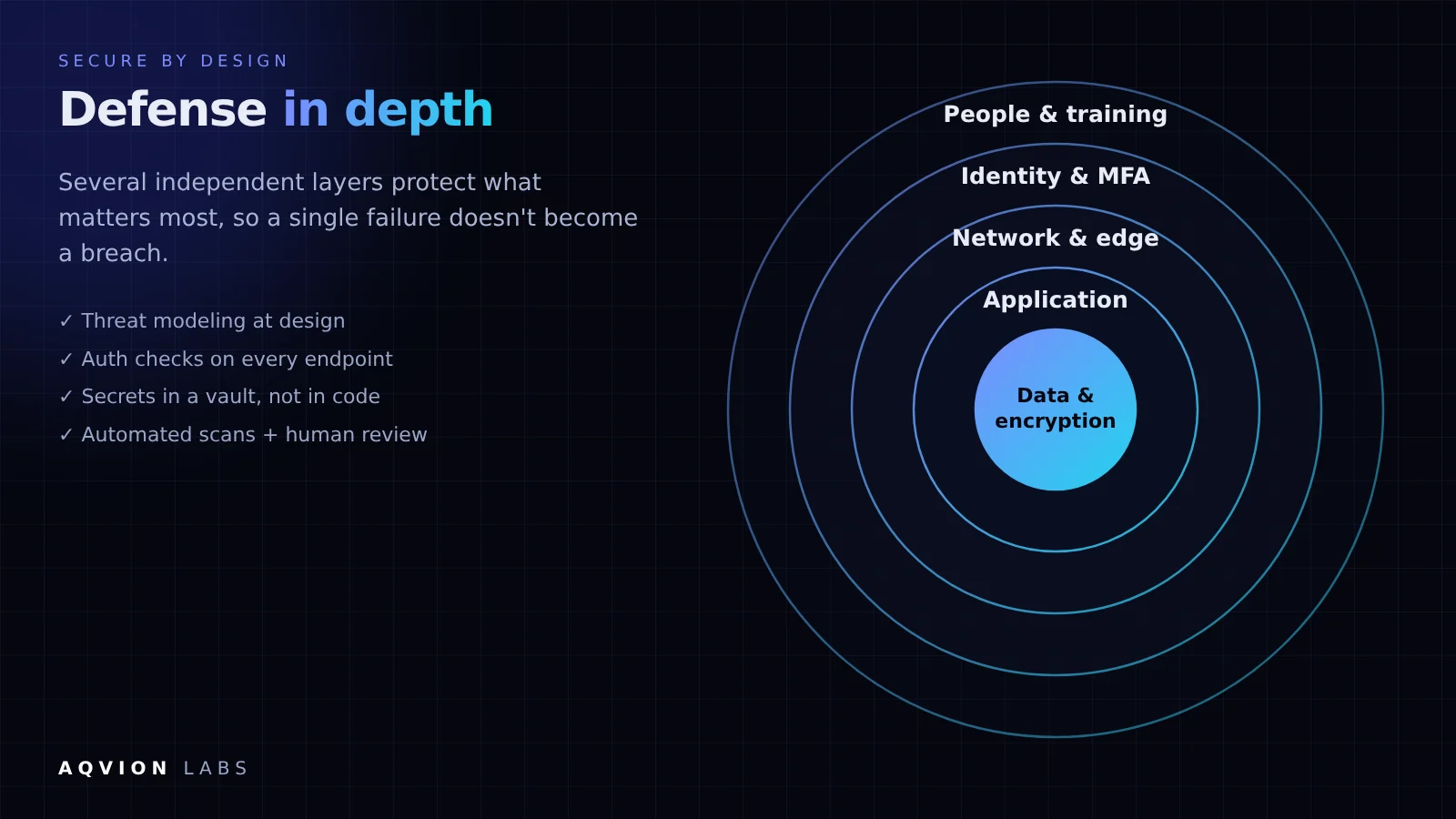
- Threat modeling at the design stage, to decide what an attacker would target and design it out.
- Strong authentication and authorization in every endpoint, not just the login page.
- Encryption of sensitive data in transit and at rest.
- Automated checks in the pipeline: static analysis, dependency and secret scanning.
- Human security review for the logic flaws scanners miss.
- Defense in depth: several independent layers, so one failure doesn't mean a breach.
How AQVION LABS builds strong cybersecurity
At AQVION LABS, security engineering is treated as a property of the system, not a review at the end. Every project we deliver, whether a web platform, AI agent, or data or blockchain system, follows the same principles:
- Threat modeling first. Before building, we work out what an attacker would actually go for, early enough that the answer can still change the design.
- Secure development. Authentication, authorization, secrets handling and cryptography are built in as the system is written. In Mindora, our journaling platform, for example, journal content is encrypted at rest and two-factor authentication is built in.
- Security review. We read codebases and configuration for the failures automated scanning doesn't find, and report each one with a fix.
- Compliance alignment. We map systems against the controls a framework expects and close the gaps. To be clear, that's alignment work, not certification, which only an accredited auditor can issue.
- Secure AI by default. For AI agents and LLM applications, we scope tool permissions tightly, guard against prompt injection, require human approval for high-impact actions and log everything.
- Secure operations. Through cloud & infrastructure and managed services, we run monitoring, patching and incident response for the systems we deliver.
Frequently asked questions
Why is cybersecurity important for small businesses?
Because attackers target them precisely because defenses are often weaker. Verizon found ransomware in 88% of breaches at small and mid-sized businesses, and recovery costs can be large compared with their revenue.
What is the most common cause of data breaches?
Stolen or abused credentials were the leading way in during 2025, followed closely by exploited software vulnerabilities and phishing. That's why MFA and fast patching give the biggest return.
How much does a data breach cost?
IBM's 2025 report puts the global average at USD 4.44 million, including detection, response, lost business and notification costs. Smaller companies spend less in absolute terms, but often more relative to their size.
What is the difference between cybersecurity and information security?
Information security protects information in any form, including paper. Cybersecurity focuses on protecting digital systems, networks and data from attack. In practice the two overlap heavily.
Does AI make cybersecurity better or worse?
Both. Attackers use AI for convincing phishing and faster exploitation. Defenders use it to detect threats and respond faster, and IBM reports that the time to contain breaches is falling. AI features you build also need their own security controls.
How do I start improving my company's cybersecurity?
Turn on phishing-resistant MFA everywhere, patch internet-facing systems, set up backups and test restoring them, remove unnecessary admin rights, and write a one-page incident response plan. Then get an independent review of your most critical application.
Get a security review from AQVION LABS
Worried about how your application, cloud setup or AI features would hold up against a real attacker? Talk to AQVION LABS about threat modeling, a security review or a secure-by-design build. We'll tell you what matters most to fix first.
Related reading: AI Agents and AGI: A 2026 Guide for Business · Blockchain & Web3 for Business: 2026 Guide.
Sources: IBM, Cost of a Data Breach Report 2025 · Verizon, 2025 Data Breach Investigations Report · OWASP Top 10. Figures are as reported at the time of writing. This article is general guidance, not legal advice.
Author
AQVION LABS engineers intelligent systems — artificial intelligence, automation, software, data platforms and cloud infrastructure — for organizations building something serious.