AQVION LABS8 min read
AI Coding Agents and Vibe Coding: A 2026 Guide for Business
AI CODINGVIBE CODINGAI AGENTSSOFTWARE ENGINEERINGAPPSEC
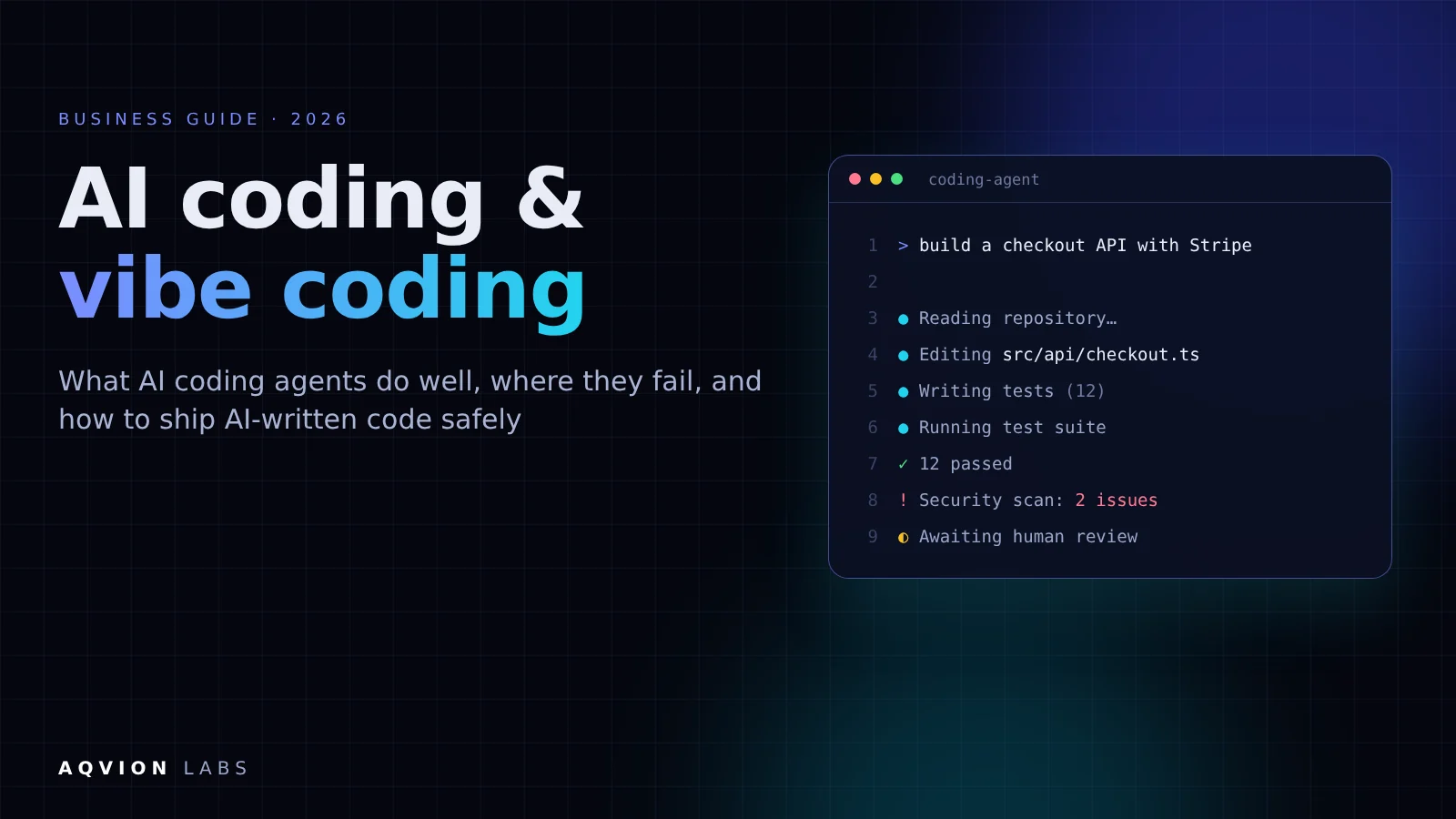
Quick answer: AI coding agents are tools that write, edit, test and even ship software from plain-English instructions. "Vibe coding" is the extreme version, where you describe what you want and accept the AI's code without reading it closely. In 2026 these tools are everywhere: 84% of developers use or plan to use AI. They're excellent for prototypes, boilerplate and tests. But research shows AI-generated code introduces security flaws in about 45% of tasks, so production software still needs engineers, tests, security scanning and human review.
Key takeaways
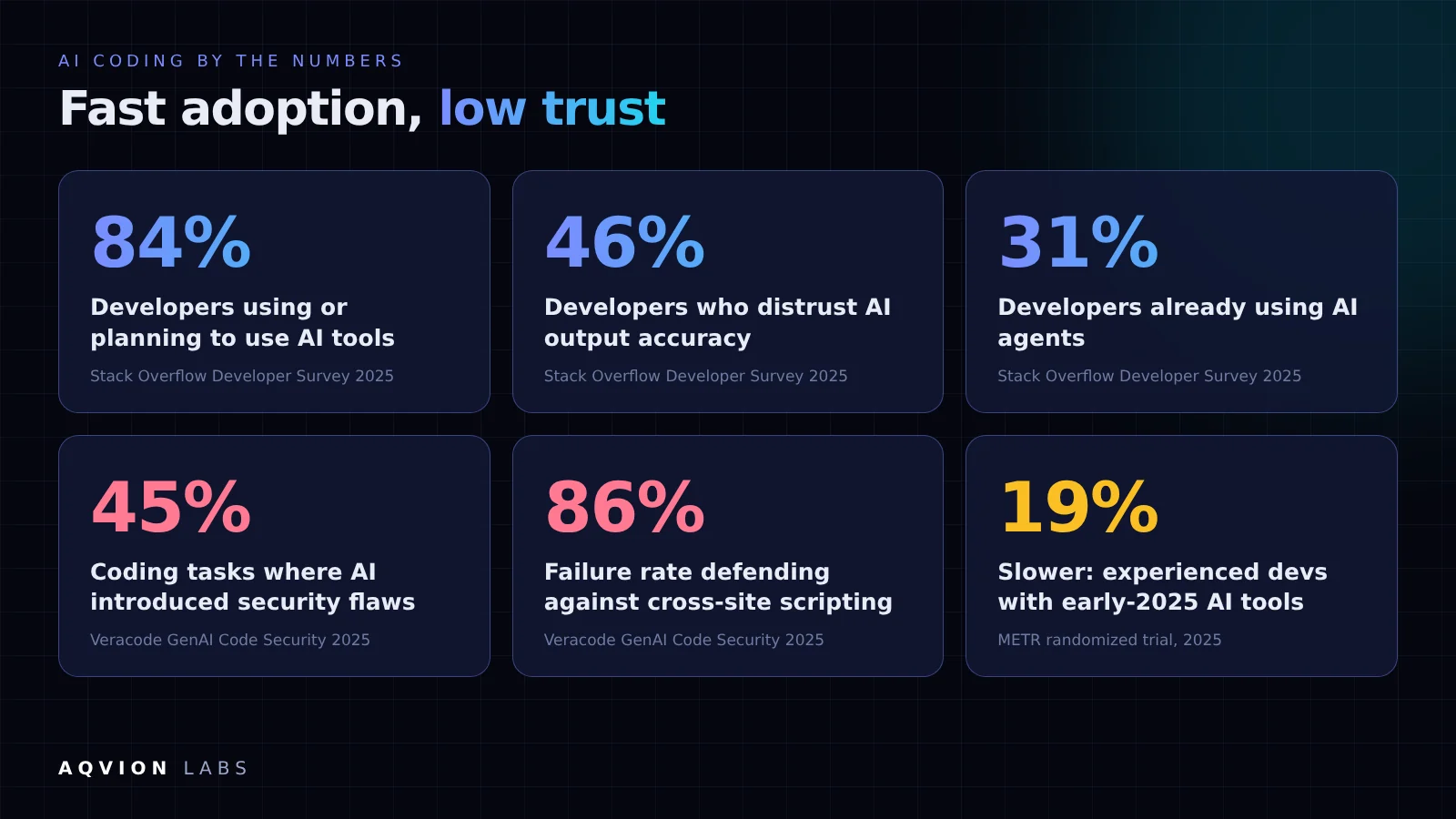
- Adoption is near-universal, trust isn't. In Stack Overflow's 2025 survey of 49,000+ developers, 84% use or plan to use AI tools, but 46% actively distrust the accuracy of AI output, up from 31% a year earlier (Stack Overflow).
- AI code is often insecure by default. Veracode tested 100+ large language models on 80 coding tasks and found they introduced vulnerabilities in 45% of cases, and failed to prevent cross-site scripting 86% of the time (Veracode via Business Wire).
- Speed gains are real, but smaller than people feel. In METR's 2025 randomized trial, experienced developers using early-2025 AI tools were 19% slower, while believing they were 20% faster. Later data with newer tools points to modest speed-ups, but METR calls it weak evidence (METR).
- Agents are going mainstream. 31% of developers already use AI agents, and another 17% plan to.
- The winners pair AI with discipline: clear specs, automated tests, security scanning and experienced review.
What is vibe coding?
The term "vibe coding" was popularized by AI researcher Andrej Karpathy in early 2025 to describe programming by conversation: you tell an AI what you want, run what it produces, paste back any errors, and repeat, without really reading or understanding the code.
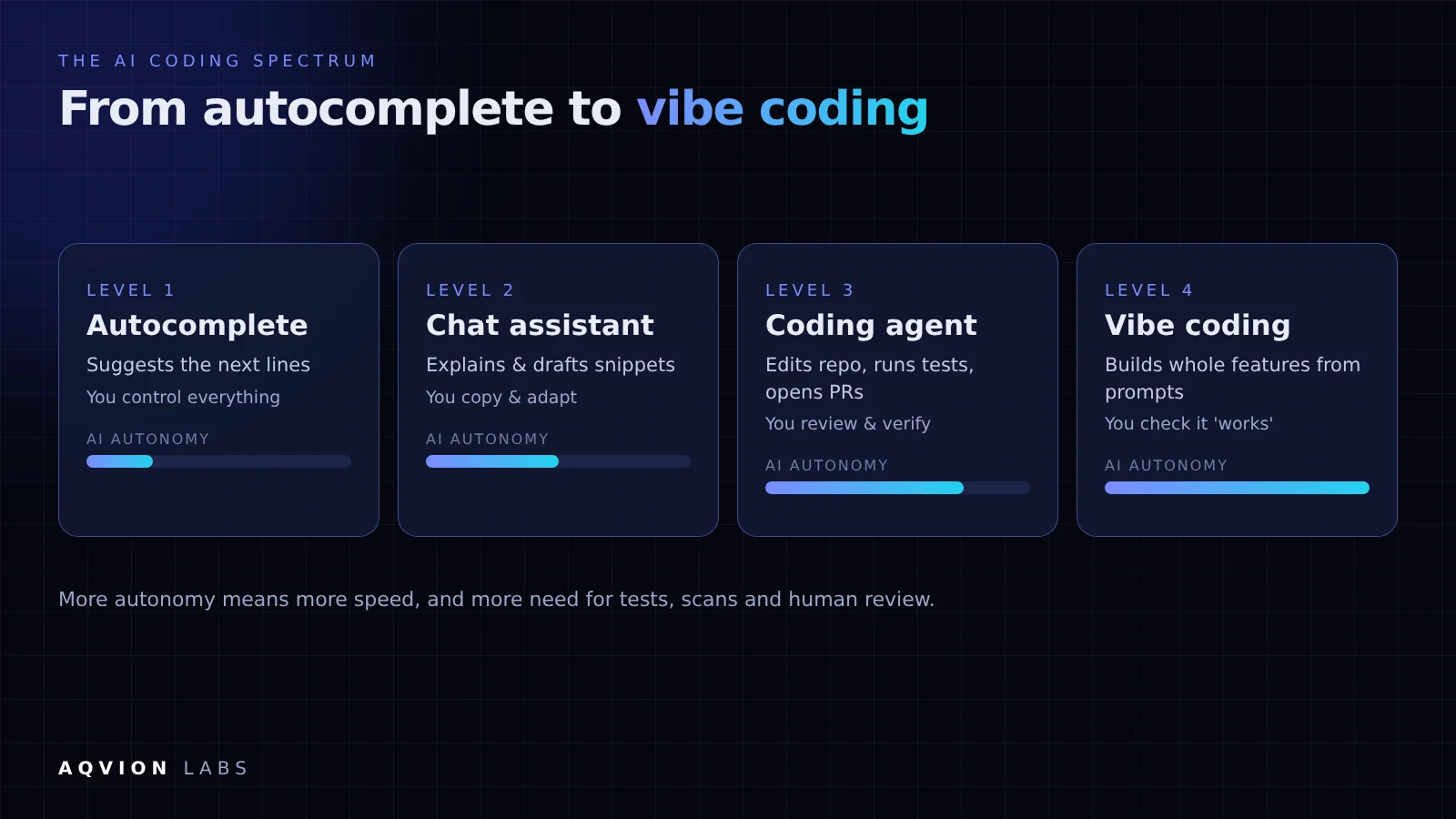
It sits at one end of a spectrum of AI-assisted development:
- Autocomplete: the AI suggests the next lines as you type, and you stay fully in control.
- Chat assistants: you ask questions and paste in snippets, and the AI explains or drafts code.
- Coding agents: the AI reads your repository, edits many files, runs commands and tests, and opens pull requests for review.
- Vibe coding: the AI builds whole features or apps from prompts, and the human mostly checks whether it "works".
Why is AI-assisted coding the hottest topic in IT right now?
Because it changes the economics of building software. A founder can produce a working prototype in an afternoon. A small team can migrate a codebase, write hundreds of tests or build an internal tool in days instead of weeks. Coding agents now work across whole repositories, run tests and iterate on their own, which turns the developer's job from typing code into specifying, reviewing and verifying it.
At the same time, the risks scale just as fast. More code, written faster, by a system that doesn't understand your business or your threat model, means more chances for bugs, security holes and technical debt to slip into production.
Where AI coding agents shine
- Prototypes and MVPs: validate an idea with real users before investing in production engineering.
- Boilerplate and scaffolding: CRUD endpoints, forms, configuration and project setup.
- Tests: generating unit and integration tests, especially for existing code.
- Migrations and refactors: framework upgrades, language migrations and repetitive changes across many files.
- Internal tools and scripts: dashboards, data clean-up and automations with low risk and few users.
- Understanding code: explaining unfamiliar codebases, tracing bugs and drafting documentation.
What are the risks of vibe coding?
1. Security vulnerabilities
AI models learn from public code, including insecure code. Without explicit guidance they often skip input validation, output encoding, authorization checks and safe secret handling. Veracode found failure rates above 70% for Java, and models failed to secure against log injection 88% of the time. Its research also found that newer and larger models weren't more secure.
2. Hallucinated and malicious dependencies
AI can suggest packages that don't exist. Attackers register those names with malicious code, an attack known as "slopsquatting". Every new dependency needs checking.
3. Leaked secrets and data
API keys pasted into prompts, hard-coded credentials and customer data sent to third-party tools are common mistakes in fast, AI-driven workflows.
4. Hidden technical debt
Code that "works" today can be duplicated, inconsistent, untested and hard to change. When nobody on the team understands it, every future change gets slower and riskier.
5. Agent permissions and prompt injection
Coding agents that can run commands, install packages or push code are powerful. A malicious instruction hidden in a README, issue or web page can trick an agent into doing something harmful if it has too many permissions.
6. Licensing and compliance
Generated code may closely resemble licensed code, and regulated industries need to show who wrote and reviewed what.
How to use AI coding agents safely in production
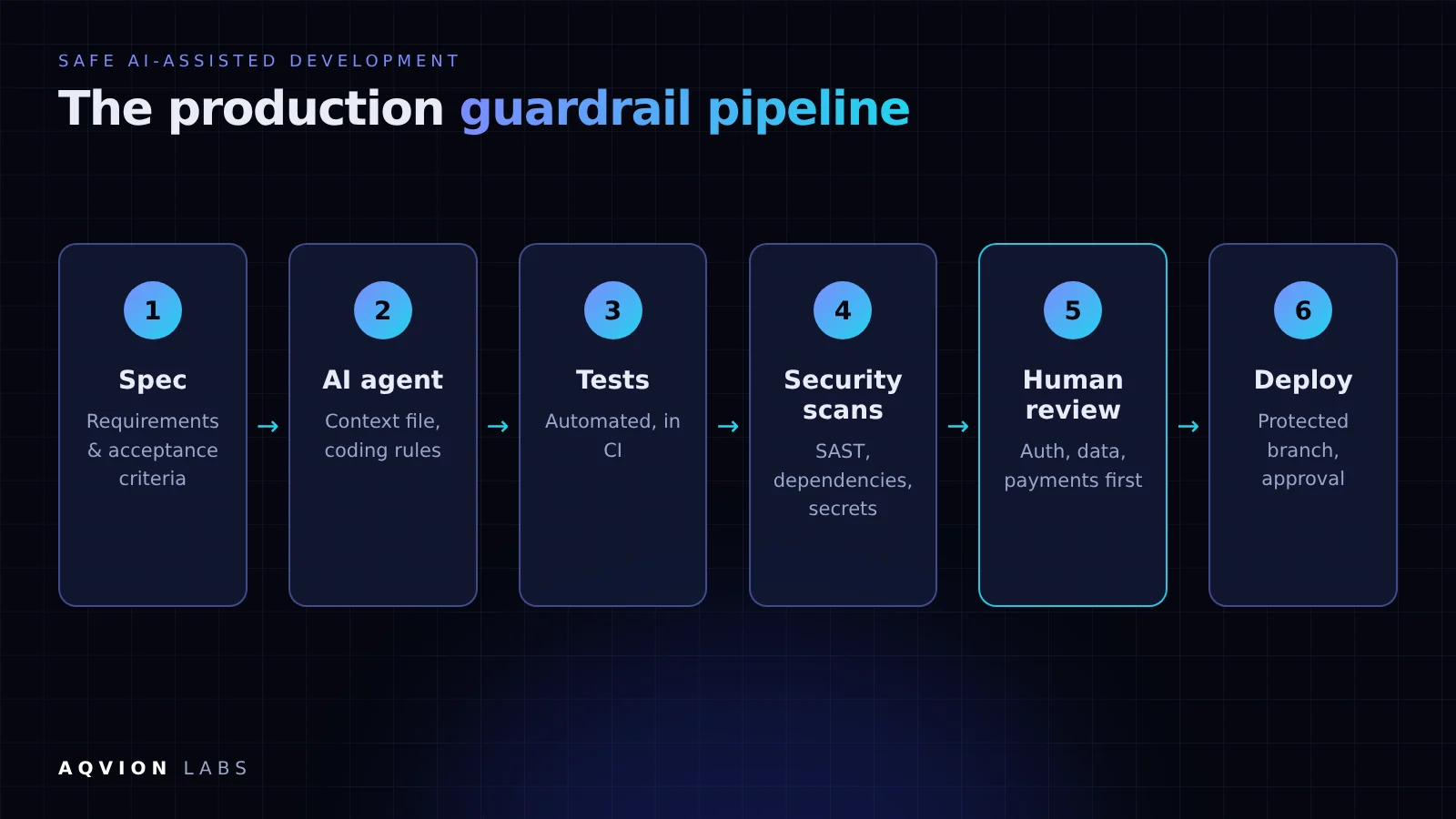
- Start with a clear spec. Write down requirements, constraints and acceptance criteria before prompting. Good input is the biggest quality lever.
- Give the agent project context. Use an instructions file (such as AGENTS.md or CLAUDE.md) with your architecture, coding standards, security rules and approved libraries.
- Tests first, always. Require automated tests for every change, and run them in CI. AI is good at writing tests, so use it.
- Scan everything automatically. Run static analysis (SAST), dependency and license scanning, and secret scanning on every pull request.
- Keep humans in the review loop. Experienced engineers review AI-written code just like human code, with extra attention to auth, data access, payments and anything security-sensitive.
- Limit agent permissions. Run agents in sandboxes, use least-privilege tokens, protect main branches and require approval before deployment.
- Measure outcomes, not lines of code. Track lead time, change failure rate, defects and incidents. Don't count how much code the AI wrote.
Prototype vs production: where vibe coding fits
Vibe coding is fine for throwaway prototypes, hackathons, personal scripts and demos to test an idea. It's not enough on its own for software that handles customer data, payments, authentication, healthcare or finance, or that the business depends on every day. The practical approach many teams use is to vibe-code the prototype, learn from users, then rebuild or harden it with proper engineering before launch.
How AQVION LABS uses AI in software engineering
AQVION LABS builds production web applications, APIs and SaaS platforms and AI-powered systems. We use AI tools where they make us faster, and we don't hand over judgment to them:
- Engineers own every line. AI-assisted code is reviewed, understood and tested like any other code.
- Security built in. Threat modeling, secure development and security review apply to AI-written code too.
- From prototype to production. If you've built an MVP with AI tools, we can review it, harden it and make it ready for real users.
- Clean handover. Documented architecture and tests, so your team can keep building with confidence.
Frequently asked questions
What does vibe coding mean?
Vibe coding means building software by describing what you want to an AI and accepting the code it produces, often without reading it in detail. The term was popularized by Andrej Karpathy in 2025.
Is AI-generated code safe to use in production?
It can be, but not by default. Studies show AI-generated code often contains security flaws, so it needs the same safeguards as human code: tests, security scanning and review by experienced engineers.
Will AI coding agents replace software developers?
They're changing the role rather than removing it. Developers spend less time typing code and more time on requirements, architecture, review, testing and security. Demand for engineers who can direct and verify AI is growing.
Do AI coding tools really make developers faster?
They often help with prototypes, boilerplate and unfamiliar code. But a 2025 randomized study found experienced developers working on their own large codebases were 19% slower with early-2025 tools, despite feeling faster. Newer tools show signs of improvement, so measure results in your own team.
What's the difference between an AI coding assistant and a coding agent?
An assistant suggests code or answers questions while you stay in control. An agent can take a goal, edit multiple files, run commands and tests, and iterate on its own before presenting the result for review.
Can a non-developer build an app with vibe coding?
Yes, for prototypes and simple internal tools. For anything handling customer data, payments or logins, have it reviewed and hardened by experienced engineers before launch.
Turn your AI-built prototype into production software
Built something with AI tools and want to launch it safely? Or want to adopt AI coding across your team without the security risks? Talk to AQVION LABS. We'll review your code, close the gaps and help you ship with confidence.
Related reading: AI Agents and AGI: A 2026 Guide for Business · Why Cybersecurity Matters: 2026 Business Guide.
Sources: Stack Overflow 2025 Developer Survey · Veracode 2025 GenAI Code Security Report, via Business Wire · METR, early-2025 developer productivity study · METR, February 2026 update. Figures are as reported at the time of writing.
Author
AQVION LABS engineers intelligent systems — artificial intelligence, automation, software, data platforms and cloud infrastructure — for organizations building something serious.