AQVION LABS8 min read
AI Agents and AGI: A 2026 Guide for Business
AIAGIAI AGENTSAGENTIC AIAUTOMATION
Quick answer: Artificial general intelligence (AGI) means an AI system that can learn and perform almost any intellectual task a skilled person can, across domains, without being retrained for each one. It doesn't exist yet. Forecasts for when it might arrive range from a few years to more than a decade. What does exist in 2026 is agentic AI: language-model systems that plan, use tools and complete multi-step work. That's where businesses are seeing real returns today.
Key takeaways
- AGI is a moving target, not a product. There's no agreed definition or test. The community forecasting site Metaculus put its median for a "general AI system" at around 2033 in early 2026, while some AI lab leaders speak of just a few years (80,000 Hours analysis).
- AI agents are already mainstream in large companies. In a 2026 survey of 500 senior leaders at large enterprises by CrewAI, a vendor of agent tools, 65% said they already use AI agents and all planned to expand in 2026 (CrewAI via Business Wire).
- The cost of intelligence is collapsing. One benchmark result went from about $4,500 per question to about $11 in a year, a drop of roughly 400×.
- The bottleneck is data and integration, not model IQ. The top barriers to scaling agents are data readiness (35%) and a shortage of skilled people (33%).
What is AGI, in plain terms?
Most AI today is narrow: it's very good at a defined job, like translating text, spotting fraud or writing code, inside guardrails people set. AGI would be general: one system that can pick up a new kind of task, reason about it, and reach human-level performance without a dedicated training project.
Researchers usually look for a combination of abilities:
- Transfer. Applying what was learned in one domain to an unfamiliar one.
- Long-horizon autonomy. Pursuing a goal over hours or days, recovering from mistakes along the way.
- Learning on the job. Improving from experience after deployment, not just during training.
- Grounded reasoning. Handling messy, ambiguous real-world situations, not only tasks with checkable answers like math or code.
Today's frontier models are strong on the first two in software and research tasks, and still uneven on the last two.
AI vs AGI vs ASI: what's the difference?
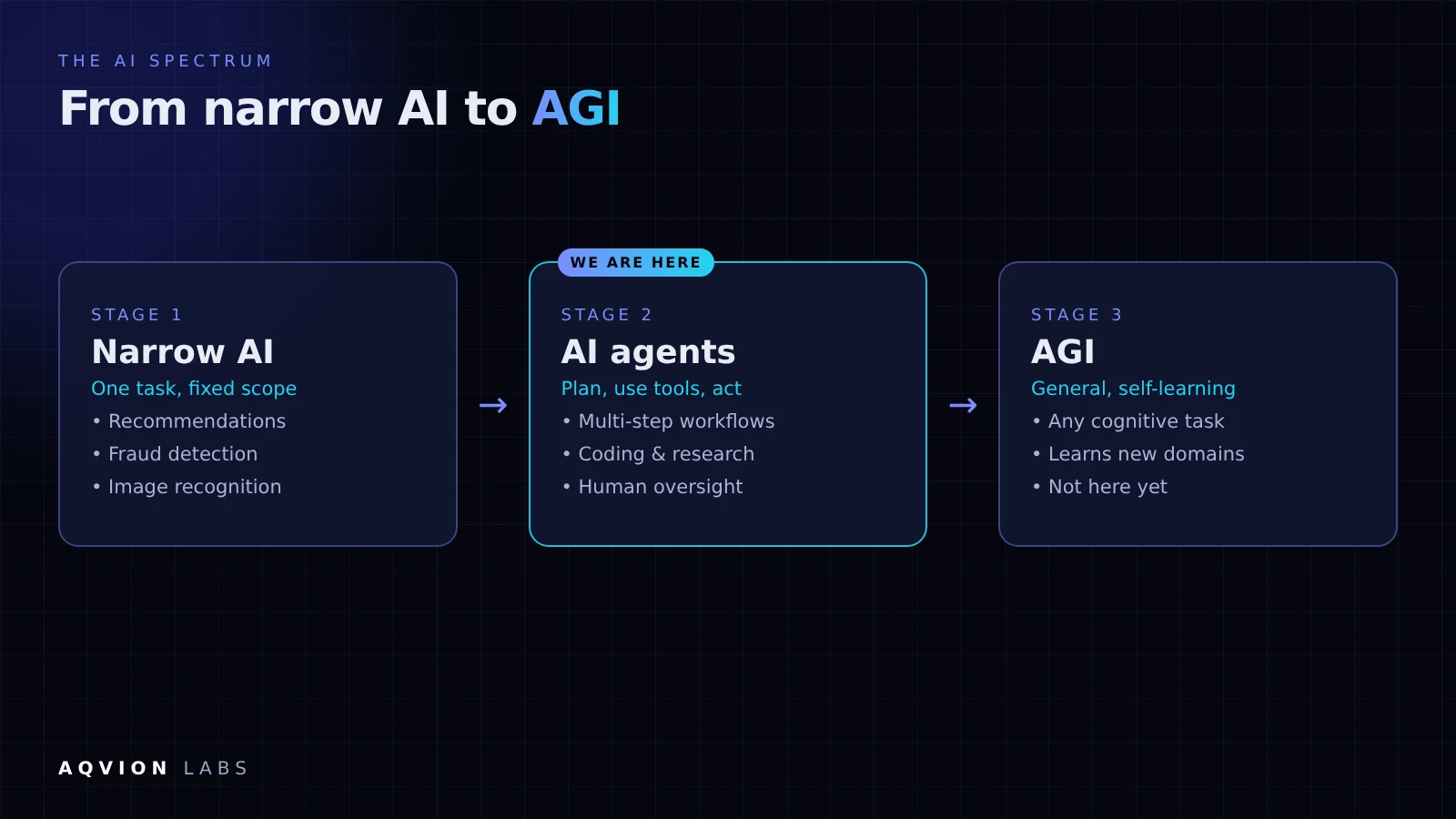
- Narrow AI: solves specific tasks. Examples include recommendation engines, image recognition and a chatbot that answers from your documents.
- Agentic AI (where we are in 2026): LLM-based systems that plan, call tools and APIs, and complete multi-step workflows with human oversight.
- AGI: human-level capability across most cognitive work, able to learn new domains on its own.
- ASI (artificial superintelligence): hypothetical systems that greatly exceed the best humans in almost every field.
How close are we to AGI?
Nobody knows, and honest answers include that uncertainty. Here's what's driving the debate:
- Capability is rising fast. Frontier models now finish software tasks that take skilled engineers hours, and the length of tasks AI can complete has been growing on an exponential trend.
- Some gains were one-offs. A large share of 2025's improvement came from letting models "think" longer at inference time. That's a lever you can't keep pulling cheaply.
- Reasoning doesn't always transfer. Big gains in math and coding haven't carried over equally to open-ended tasks in the physical and commercial world.
- Expert views differ. Some lab leaders talk about two to five years. Long-time skeptics now say about a decade. Community forecasts sit in between.
For a business, the practical conclusion is the same whichever camp is right. Every serious organization is going to run on AI agents for a growing share of its knowledge work, and the companies that build the data, tooling and governance now will absorb each new model generation fastest.
What is an AI agent, and how does it work?
An AI agent is software that uses a language model to decide what to do next toward a goal, then acts through tools. A production agent has five parts:
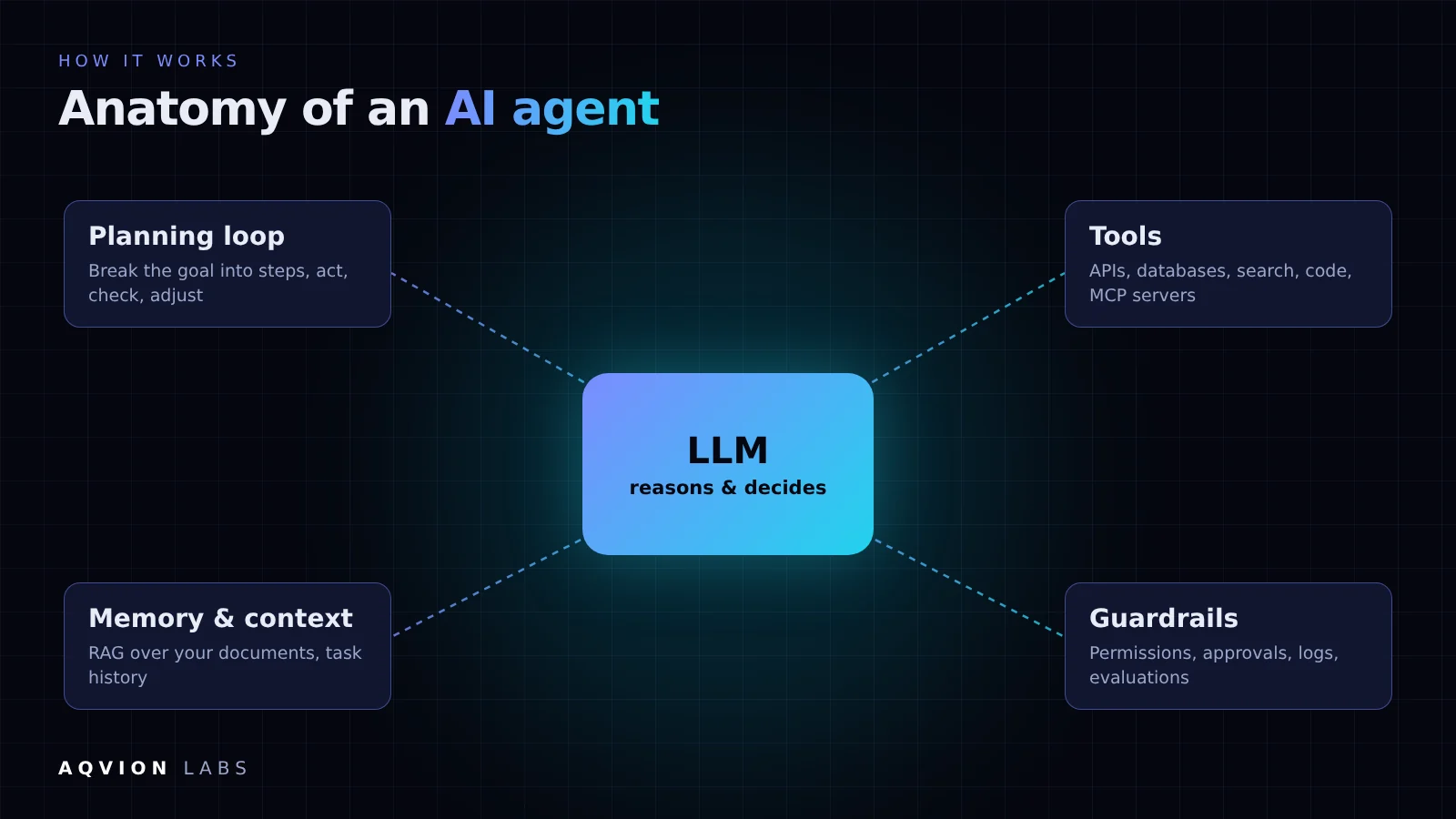
- Model: the LLM that reasons and writes, often with a smaller, cheaper model for routine steps.
- Planning loop: breaks a goal into steps, acts, checks the result and adjusts.
- Tools: APIs, databases, search, email or code execution, increasingly connected through open standards such as the Model Context Protocol (MCP).
- Memory and context: retrieval (RAG) over your documents, plus a record of what's already been done.
- Guardrails and oversight: permissions, human approval for risky actions, logging and evaluation.
Where are AI agents delivering value in 2026?
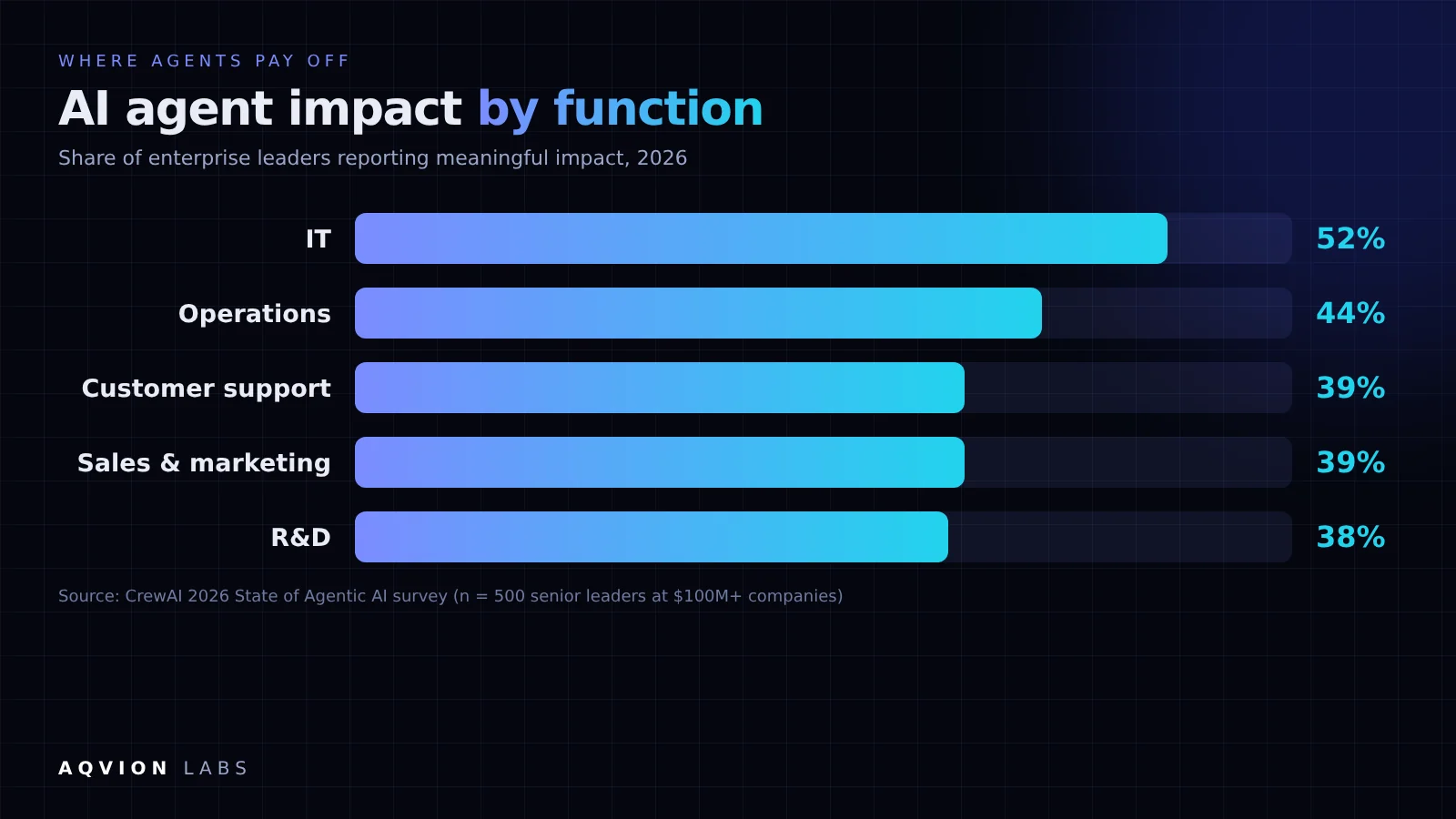
In the CrewAI survey, leaders reported the most meaningful impact in IT (52%), operations (44%), customer support and sales & marketing (39% each) and R&D (38%). Typical examples:
Customer support
Agents resolve common tickets end to end (refunds, order changes, account questions) and hand edge cases to people with a summary already written.
Operations and back office
Invoice processing, document review, compliance checks and reconciliation. These are rule-heavy but full of unstructured documents, which is exactly where LLMs beat older automation.
Software engineering and IT
Coding agents write, test and review code. IT agents triage incidents, reset access and keep runbooks up to date.
Sales and marketing
Research on leads, personalized outreach drafts, CRM hygiene and content production, with a human approving what goes out.
How to adopt AI agents without the common mistakes
- Start with one painful, measurable workflow. Pick something with clear volume, cost and error data, so you can prove ROI.
- Fix the data first. Agents are only as good as the context they can reach. Clean up access, permissions and document quality.
- Design the human-in-the-loop. Decide which actions an agent can take alone, which need approval, and which it must never take.
- Build evaluations before scaling. Test against real past cases, track accuracy and cost per task, and monitor drift in production.
- Stay model-agnostic. Keep prompts, tools and evaluations separate from any single provider, so you can switch as models improve and prices fall.
- Treat security as a feature. Prompt injection, data leakage and over-broad tool permissions are the real risks. Apply least privilege and log everything.
AI trends to watch on the road to AGI
- Longer-running agents that work for hours on a task and report back.
- Computer-use agents that operate ordinary software interfaces, not just APIs.
- Smaller, specialized models running cheaply on-device or in your own cloud.
- Multi-agent systems where specialist agents hand work to each other.
- AI governance and regulation, including the EU AI Act's obligations phasing in for general-purpose and high-risk systems.
Frequently asked questions
Does AGI exist yet?
No. Today's best models are highly capable and increasingly autonomous, but no system reliably learns any new domain on its own at human level. There's also no agreed test that would prove AGI has arrived.
When will AGI arrive?
Estimates vary widely. Some AI lab leaders suggest a few years. Aggregated community forecasts in early 2026 pointed to the early 2030s, and some well-known researchers expect it to take a decade or more.
What's the difference between generative AI and agentic AI?
Generative AI produces content (text, images, code) in response to a prompt. Agentic AI uses that capability to take actions: planning steps, calling tools and finishing a task with limited supervision.
Will AI agents replace jobs?
They're changing them. In 2026, agents mostly take over repetitive steps inside a role, such as drafting, searching, data entry and first-line triage, so people can focus on judgment, relationships and exceptions. The impact varies a lot by task and industry.
How much does it cost to build an AI agent?
A focused agent for one workflow, built on an existing model API with a few tool integrations, is a modest project. Costs grow with the number of integrations, compliance requirements and the evaluation and monitoring needed for production. Model usage costs keep falling year on year.
Is it safe to let AI agents act on company systems?
It can be, with the right controls: scoped permissions, approval steps for high-impact actions, audit logs, protection against prompt injection, and ongoing evaluation. Start with low-risk actions and widen autonomy as the agent proves itself.
Build AI agents with AQVION LABS
AQVION LABS designs and engineers AI and intelligent systems: AI agents, LLM applications, RAG and decision systems, plus the automation and data engineering they depend on. Every system ships with evaluations, monitoring and security engineering built in.
Have a workflow you want an agent to handle? Start a project with us and we'll tell you honestly whether an agent, simpler automation or nothing at all is the right answer.
Related reading: Blockchain & Web3 for Business: 2026 Guide.
Sources: 80,000 Hours, "What happened with AGI timelines in 2025?" · CrewAI 2026 State of Agentic AI survey, via Business Wire · AIMultiple, analysis of AGI predictions. Survey figures are self-reported by a vendor, and forecasts change often.
Author
AQVION LABS
AQVION LABS engineers intelligent systems — artificial intelligence, automation, software, data platforms and cloud infrastructure — for organizations building something serious.
