AQVION LABS9 min read
Autonomous Exposure Remediation: A 2027 Guide for Business
CYBERSECURITYAUTONOMOUS EXPOSURE REMEDIATIONVULNERABILITY MANAGEMENTCTEMAI AGENTSGARTNER 2027
Last updated: October 30, 2026
Quick answer: Autonomous exposure remediation (AER) uses AI and automation to find, prioritize, fix and verify security weaknesses with far less manual work. Gartner named it one of its top strategic technology trends for 2027 because attackers now exploit flaws in hours while most teams still take weeks to patch. The safe way to adopt it is gradually: automate low-risk fixes first, keep humans approving high-impact changes, and measure every rollout.
Key takeaways
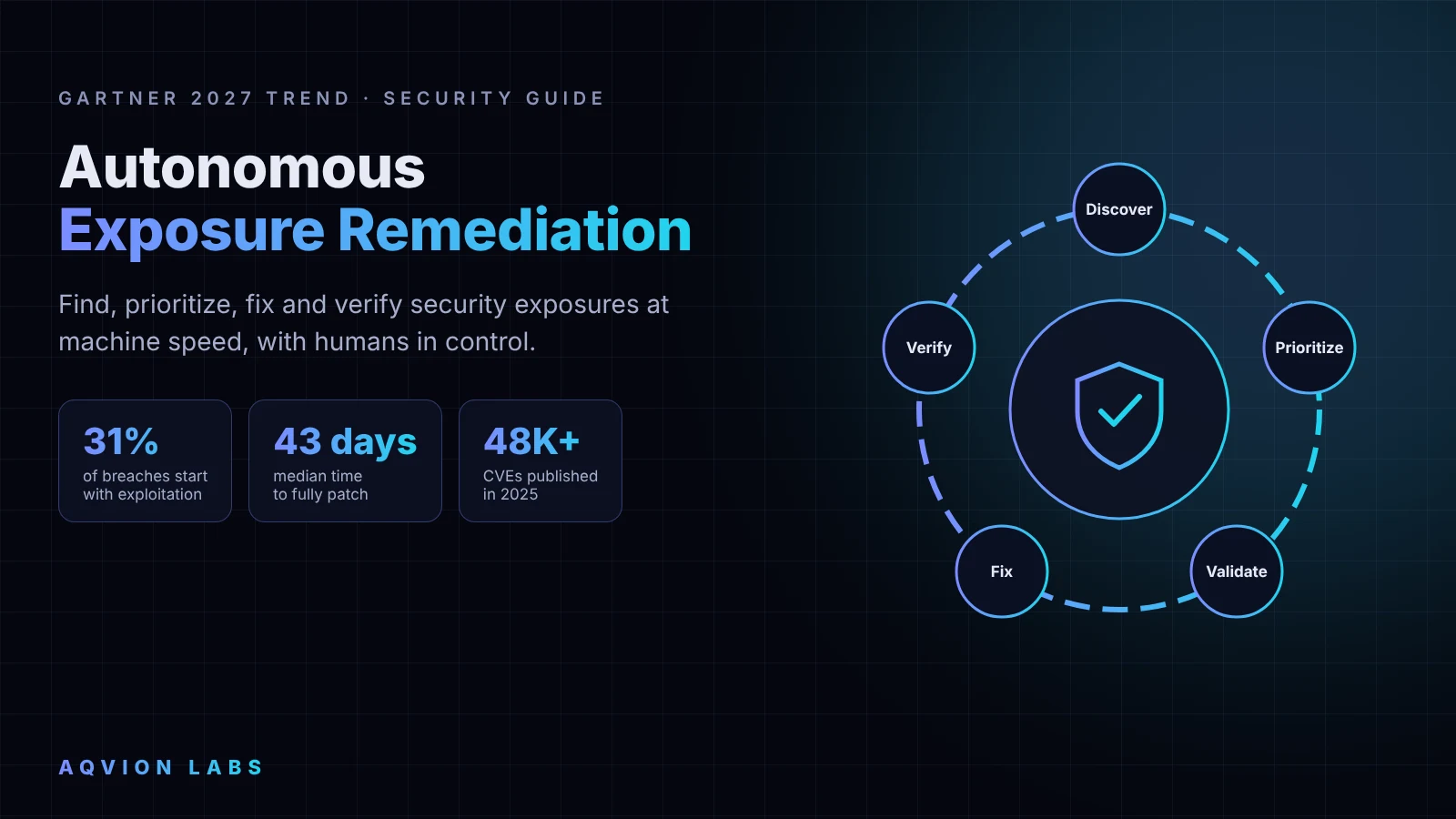
- Vulnerability exploitation is now the #1 way breaches start, at 31% of initial access in the Verizon 2026 DBIR, up from 20% a year earlier.
- The median time to fully patch rose to 43 days in 2025, up from 32 days (SecurityWeek on the DBIR).
- A record 48,185 CVEs were published in 2025, about 131 a day (Jerry Gamblin's 2025 CVE Data Review).
- The global average breach now costs a record $4.99 million (IBM Cost of a Data Breach 2026).
- Gartner lists autonomous exposure remediation among its top strategic technology trends for 2027.
What is autonomous exposure remediation?
Autonomous exposure remediation (AER) is a cybersecurity approach in which AI agents and automation find, prioritize, fix and verify security exposures with limited human intervention. It handles the "fix it" side of security. Instead of a scanner producing a long list of findings that someone turns into tickets, an AER system:
- Discovers exposures: missing patches, misconfigurations, exposed services, vulnerable libraries and leaked secrets.
- Prioritizes them by real-world risk: is the flaw being exploited, is the asset reachable from the internet, does it hold sensitive data?
- Validates whether the issue is actually exploitable in your environment.
- Fixes it: deploys a patch, changes a configuration, upgrades a dependency or opens a pull request.
- Verifies the fix worked and nothing broke, and rolls back if it did.
Gartner describes AER as combining AI and automation to scan, manage and fix vulnerabilities, including deploying patches and testing changes, and expects it to become part of the "coding harness" that governs AI-assisted software development (TechTarget's summary of the Gartner trends).
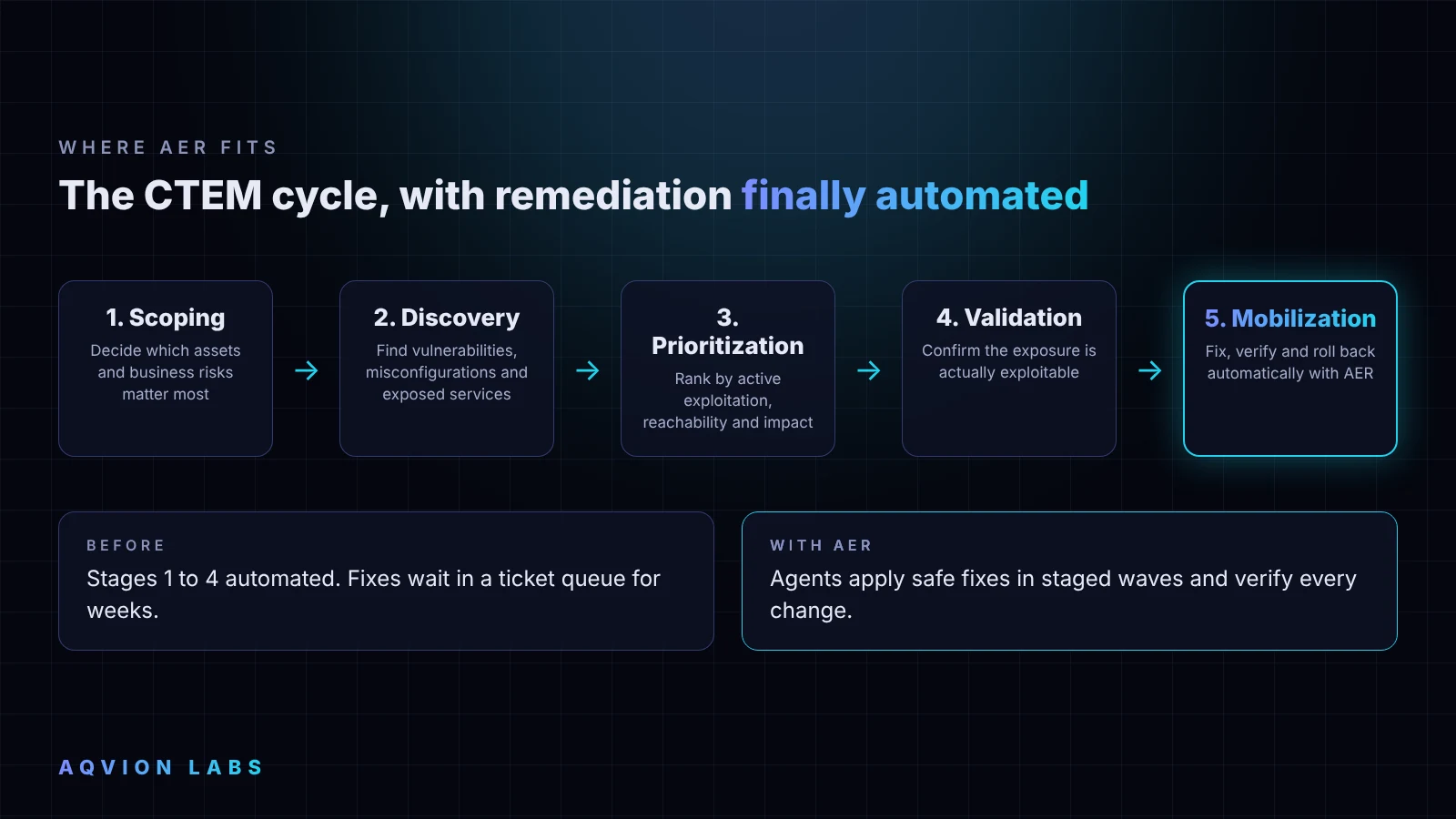
AER builds on continuous threat exposure management (CTEM), the five-stage cycle Gartner introduced in 2022: scoping, discovery, prioritization, validation and mobilization. For years, tools automated the first four stages well. Mobilization, actually getting things fixed, stayed manual. AER closes that loop.
Why does autonomous exposure remediation matter now?
Three trends have collided.
1. Attackers got faster. Verizon's 2026 DBIR found that exploitation of vulnerabilities overtook stolen credentials and phishing as the most common entry point for the first time in the report's history. Researchers also reported that threat actors are using AI to speed up exploitation, shrinking the defender's window from months to hours. VulnCheck found that nearly 29% of vulnerabilities added to CISA's Known Exploited Vulnerabilities catalog in 2025 were exploited on or before the day their CVE was published.
2. Defenders got slower. The same DBIR shows the median time to fully remediate rose to 43 days. That gap, hours to exploit versus weeks to patch, is where breaches happen.
3. The volume exploded. CVE publication hit a record in 2025 and kept climbing in 2026. NIST itself moved the National Vulnerability Database to risk-based triage in April 2026 because it could no longer fully analyze every submission. If the national database can't keep up manually, a five-person IT team certainly can't.
There is a fourth, newer driver: AI coding agents. Teams now ship code faster than humans can review it. Gartner's Gene Alvarez warned that AI systems are generating software faster than people can check it. More code, shipped faster, means more potential exposures. Remediation has to speed up to match.
How does autonomous exposure remediation work in practice?
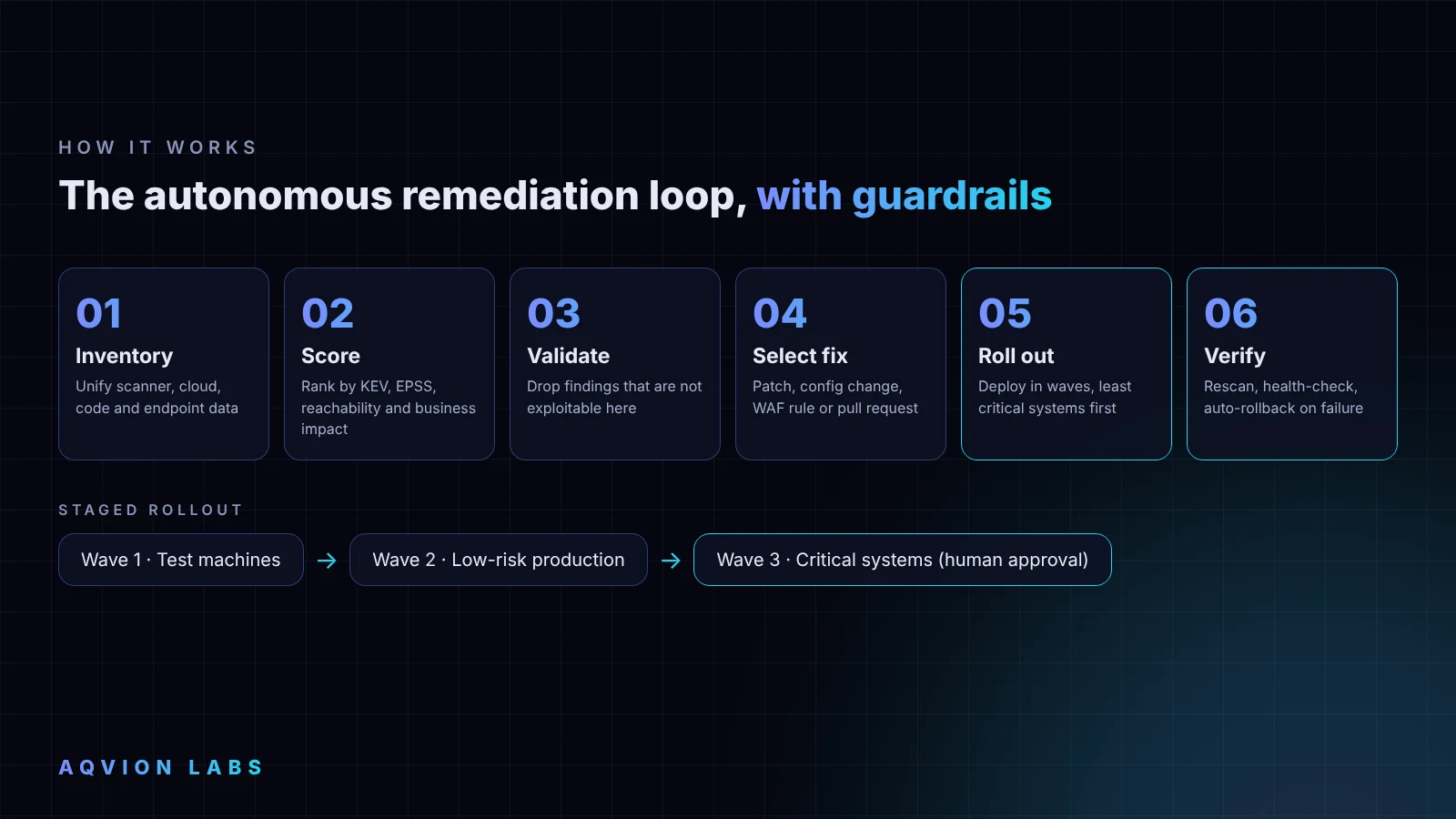
Most AER setups follow a closed loop with guardrails at each step.
- Unified inventory. Agents pull data from scanners, cloud accounts, code repositories and endpoint tools into one list of assets and exposures.
- Context-based risk scoring. Each exposure is scored on exploit activity (such as the CISA KEV list or EPSS), reachability and business impact, not just its CVSS severity.
- Exploitability validation. The system checks whether the vulnerable code path is actually reachable. Vendors report this removes a large share of "theoretical" findings before any work is done.
- Fix selection. The agent chooses the safest effective action: a patch, a configuration change, a compensating control such as a WAF rule, or a code change in a pull request.
- Staged rollout. Changes go out in waves, starting with the least critical systems, so a bad patch affects test machines before production.
- Verification and rollback. The system rescans, runs health checks and reverts automatically if something fails.
Vendors are already shipping this. Qualys, for example, reports deploying 178 million patches in a year, 40 million of them fully autonomously, with a rollback rate under 0.1% (Qualys blog). These are vendor figures, not independent audits, but they show autonomous patching is operating at real scale.
What are the risks of autonomous remediation?
Letting software change production systems on its own carries real risk. The main ones:
- Outages from bad fixes. A patch that breaks a payment flow can cost more than the vulnerability it closed. Staged rollouts and automatic rollback are non-negotiable.
- Over-privileged agents. A remediation agent needs broad access to change systems, which makes it an attractive target. Gartner separately predicts that ungoverned AI agents will cause 25% of enterprise breaches by 2028.
- Wrong prioritization. If asset data is stale or business context is missing, the agent may fix the wrong things first and give a false sense of safety.
- Silent drift. Automated changes that nobody reviews can accumulate into configurations no one understands.
- Vendor lock-in. Handing remediation to one platform can make it hard to switch later.
- Accountability gaps. Regulators and auditors still expect a human to own security decisions. "The agent did it" is not an acceptable answer.
There is also a measurement caveat. Gartner predicted back in 2022 that organizations running CTEM programs would be three times less likely to suffer a breach by 2026. Early evidence points in the right direction, but no published study has yet confirmed that figure. Treat vendor and analyst promises as hypotheses to test in your own environment.
How to adopt autonomous exposure remediation safely
You don't need a large security team to start. A practical path for small and mid-sized businesses:
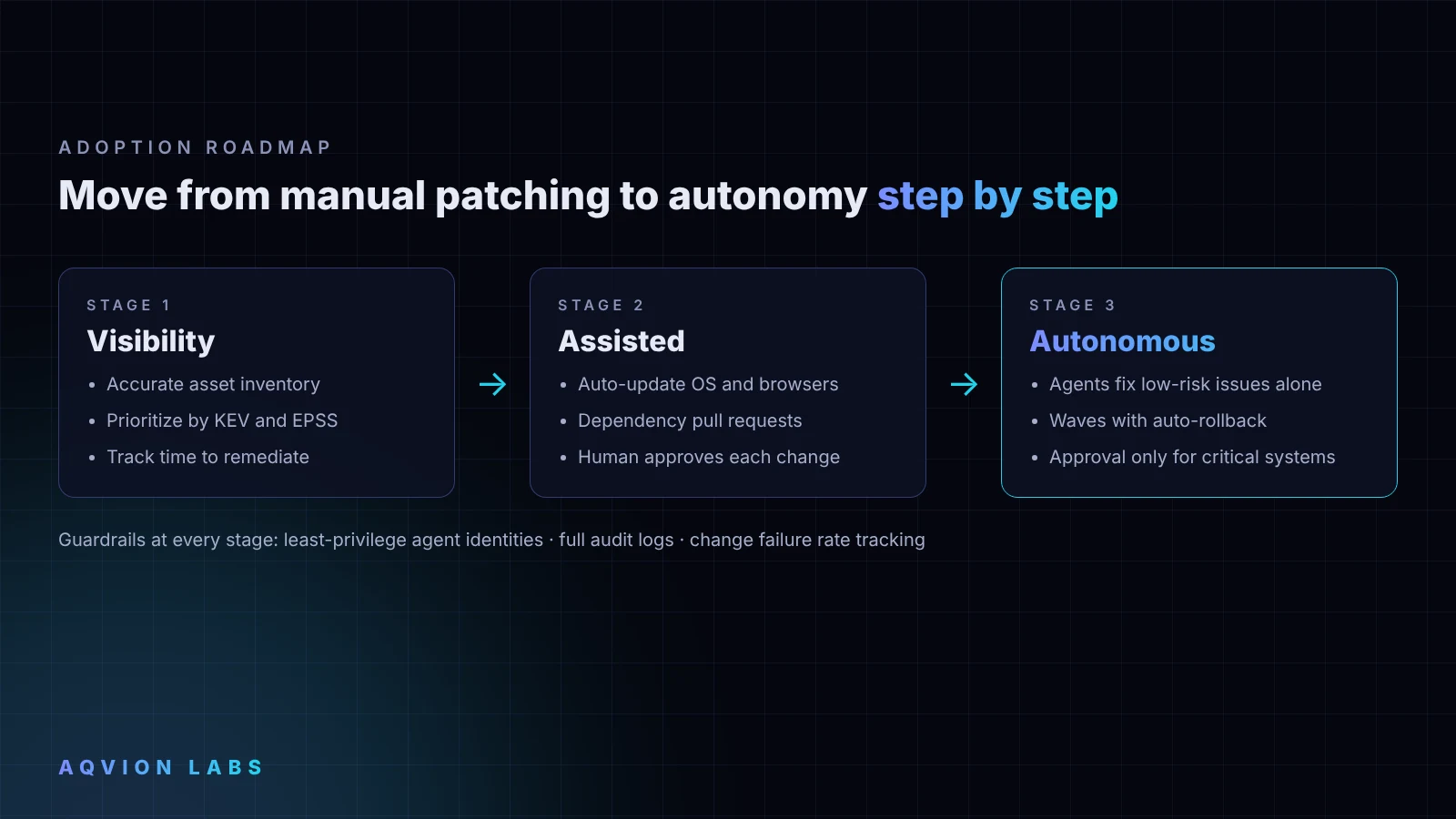
- Build an accurate asset inventory. You can't fix what you can't see. List servers, cloud resources, laptops, SaaS apps, domains and code repositories.
- Prioritize by exploitation, not severity. Use the CISA KEV catalog and EPSS scores so internet-facing, actively exploited flaws come first.
- Automate the safe, repetitive fixes first. Browser and OS updates, dependency bumps through automated pull requests and common misconfigurations are good starting points.
- Keep humans in the loop for high-impact systems. Production databases, payment systems and identity providers should need approval before changes.
- Roll out in waves with automatic rollback. Test machines first, then low-risk production, then critical systems.
- Give remediation agents their own identity and least privilege. Scope credentials tightly, rotate them, and log every action.
- Track three metrics: mean time to remediate, percentage of known-exploited vulnerabilities fixed within your target window, and change failure rate.
- Review monthly and expand gradually. As confidence grows, move more categories of fixes from "approve" to "automatic."
How AQVION LABS helps with exposure remediation
AQVION LABS helps businesses close the gap between finding security issues and fixing them, without risking production.
- Security: threat modeling, secure development (in our Mindora platform, data is encrypted at rest and 2FA is built in), security reviews and compliance alignment.
- Automation: remediation workflows that open tickets or pull requests, route approvals and verify fixes automatically.
- Cloud: hardening cloud configurations and building staged deployment pipelines with rollback.
- AI: designing AI agents with scoped identities, audit logs and human approval for high-impact actions.
Frequently asked questions
What is the difference between vulnerability management and exposure remediation?
Vulnerability management focuses on finding and scoring known software flaws. Exposure remediation covers a wider set of weaknesses, including misconfigurations, exposed services and leaked credentials, and focuses on actually fixing and verifying them.
Is autonomous remediation safe for production systems?
It can be, with guardrails. Staged rollouts, automatic rollback, health checks and human approval for critical systems reduce the risk of a fix causing an outage. Start with low-risk categories and expand gradually.
Do small businesses need autonomous exposure remediation?
Small businesses are often the ones that benefit most, because they rarely have staff to patch everything manually. Even simple automation, such as automatic OS updates and dependency pull requests, closes many common gaps.
How does AER relate to CTEM?
CTEM is Gartner's five-stage framework for managing exposures: scoping, discovery, prioritization, validation and mobilization. AER automates the last stage, mobilization, which has historically been the slowest and most manual.
Will autonomous remediation replace security teams?
No. It removes repetitive patching work so people can focus on architecture, risk decisions, incident response and the complex fixes that need judgment. Humans still own policy and accountability.
What should I measure to know it is working?
Track mean time to remediate, the share of known-exploited vulnerabilities fixed within your target window, change failure rate and rollback frequency. If remediation is faster and failures stay low, it is working.
Ready to close the gap between finding vulnerabilities and fixing them? Talk to AQVION LABS about a security review and a remediation plan that fits your team.
Related reading: Why Cybersecurity Matters: 2026 Business Guide · AI Coding Agents and Vibe Coding: A 2026 Guide for Business · Post-Quantum Cryptography: A 2026 Guide for Business
Sources: Gartner, "Top Strategic Technology Trends for 2027" (Oct 2026), via TechTarget; Verizon 2026 Data Breach Investigations Report, via SecurityWeek; IBM Cost of a Data Breach Report 2026; Jerry Gamblin, 2025 CVE Data Review; VulnCheck 2026 exploitation research; NIST NVD triage update (Apr 2026), via SiliconANGLE; Gartner CTEM research (2022–2023); Qualys (vendor-reported figures).
Author
AQVION LABS engineers intelligent systems — artificial intelligence, automation, software, data platforms and cloud infrastructure — for organizations building something serious.