AQVION LABS8 min read
How to Get Your Business Recommended by ChatGPT and AI Search
AI SEARCHGEOAEOCHATGPTSEO
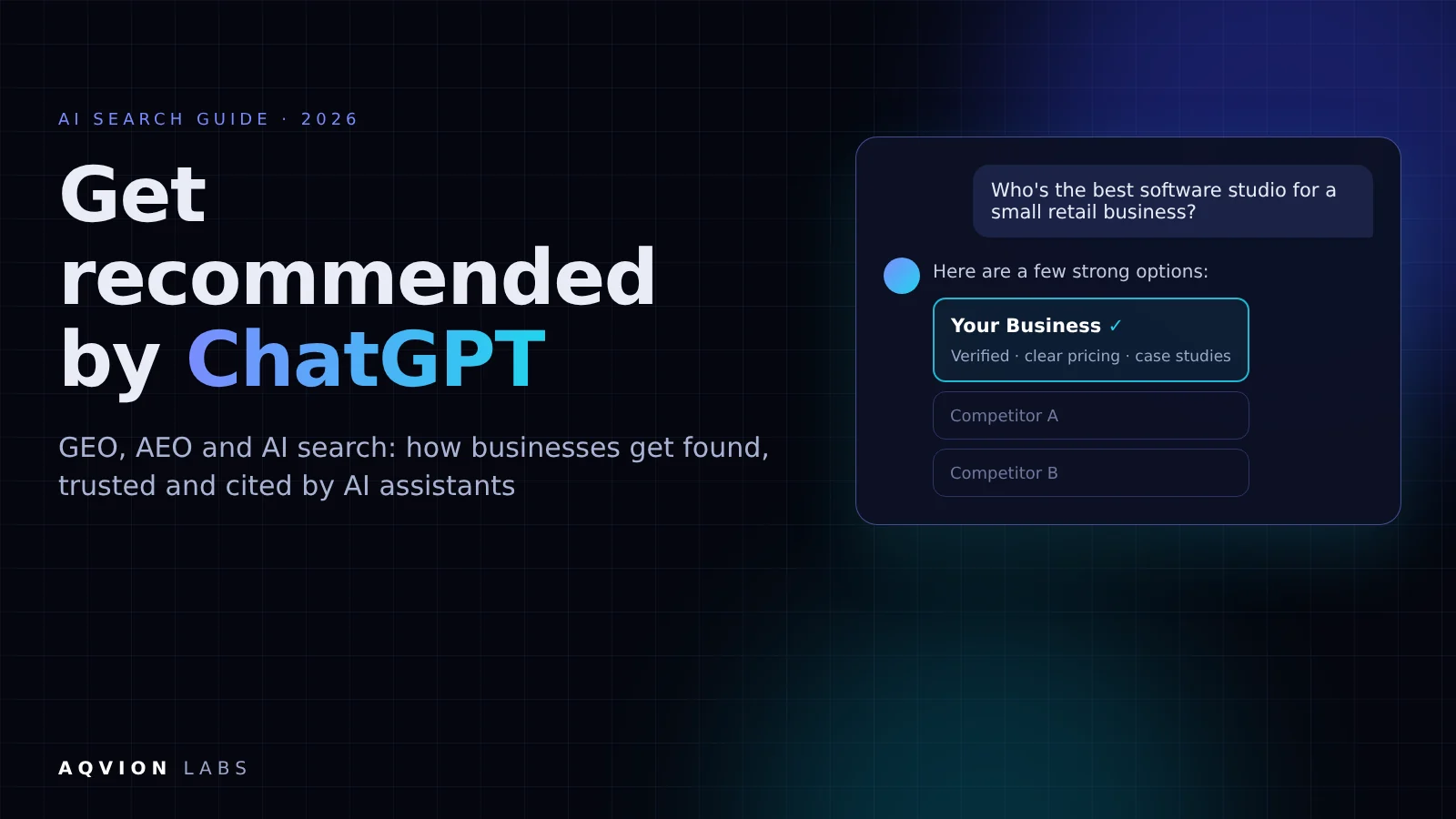
Quick answer: To get your business recommended by ChatGPT and other AI assistants, make it easy for them to find, understand, trust and cite you. Claim your verified profile where it's available (OpenAI launched "Businesses in ChatGPT" in beta on November 10, 2026). Make sure your website clearly answers the questions customers ask, with facts, prices, FAQs and structured data. Earn mentions on trusted third-party sites, and keep your content fresh. Paying for ads doesn't buy organic recommendations, so clear, credible, well-structured information is what counts.
Key takeaways
- ChatGPT now has business profiles. OpenAI's "Businesses in ChatGPT" beta lets companies claim a verified profile with a blue check, update details, prices and stock, and see how often ChatGPT mentions them and how many users click through. Eligible US e-commerce and online-service firms can also launch a Business Agent (The Next Web).
- The audience is huge. OpenAI cites 1.2 billion weekly ChatGPT users.
- Ads don't buy recommendations. OpenAI says paying doesn't change how often ChatGPT recommends a business, according to reporting cited by The Next Web.
- Third-party mentions matter most. In one analysis of 83,670 AI citations, about 83% pointed to third-party sites rather than brands' own websites (Analyze AI).
- Facts, structure and freshness help. Research summarized by Analyze AI found that adding specific statistics raised the chance of being cited by about 37% (Princeton GEO study), and that 65% of AI bot visits target content less than a year old.
What is AI search optimization (GEO, AEO, AIO)?
People increasingly ask AI assistants instead of scrolling search results: "Who's the best software agency for a small retail business?" or "Which accounting firm in Dubai handles VAT for startups?" The assistant answers with a few names, often with links.
Optimizing for those answers has several overlapping names:
- GEO (generative engine optimization): making your content more likely to be used and cited in AI-generated answers.
- AEO (answer engine optimization): structuring content as direct answers to specific questions.
- AIO (AI optimization): a broader term for making your brand understandable to AI systems.
They all build on solid SEO. AI assistants still rely on web search, crawling and trusted sources, so the foundations haven't changed. What changes is how your information needs to be packaged.
How do ChatGPT and AI assistants choose which businesses to recommend?
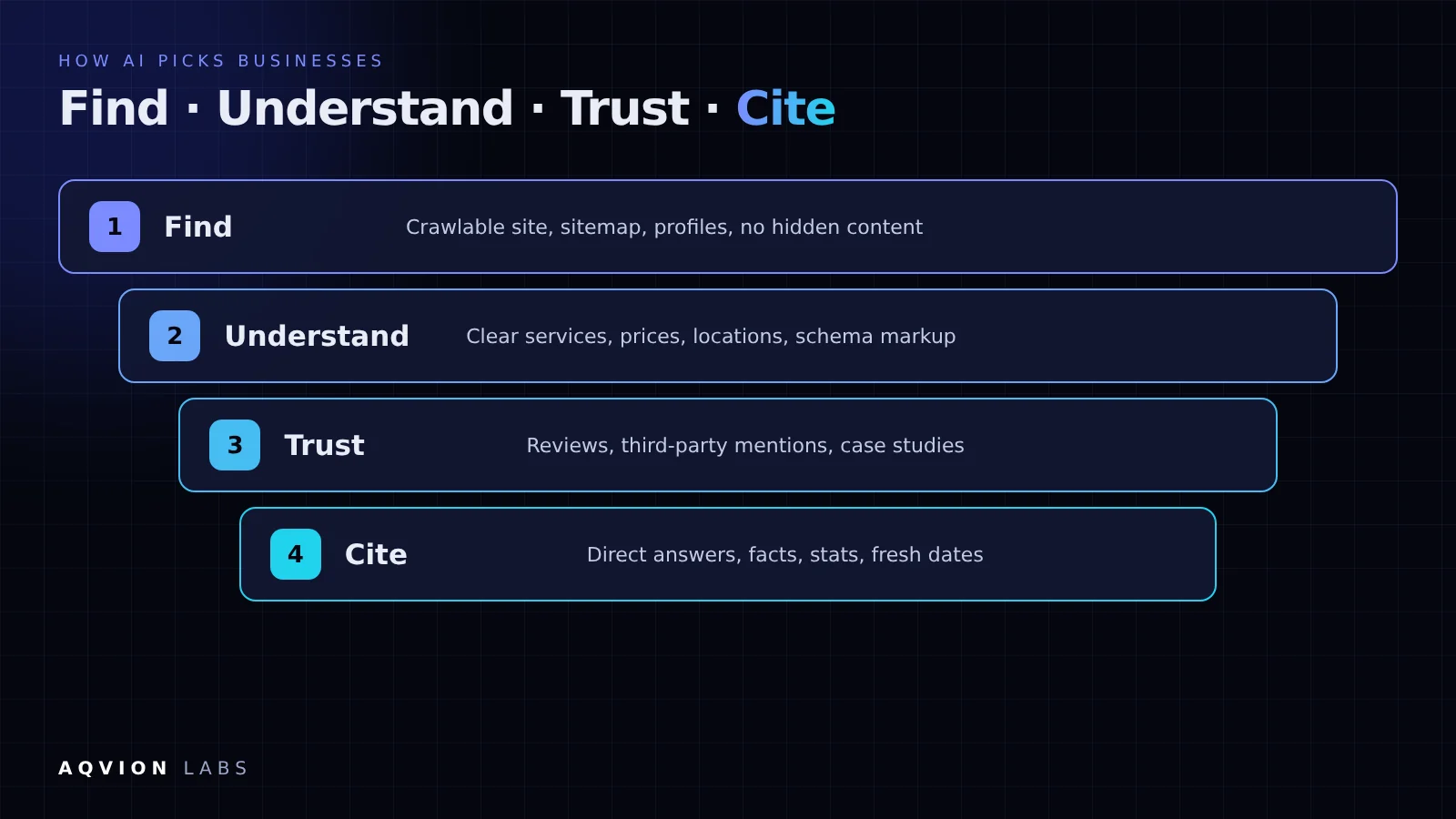
No assistant publishes a ranking formula, but the pattern is consistent. An AI assistant is more likely to recommend you when it can:
- Find you: your site can be crawled and appears in the search results the assistant uses.
- Understand you: your pages clearly state what you do, for whom, where, and at what price.
- Trust you: independent sources (reviews, directories, articles, case studies) confirm your claims.
- Cite you: your content gives clear, quotable answers with facts and sources.
What is "Businesses in ChatGPT"?
Announced on November 10, 2026 as a beta, it gives companies a Business Hub inside ChatGPT:
- Verified profile: claim your business, get a blue check, and keep details, prices and stock up to date.
- Visibility analytics: see how often ChatGPT mentions you, how many users click through, and common conversation topics. OpenAI says it doesn't share users' chats with businesses.
- Business Agents (eligible US firms): an AI agent that answers customer questions using your product information. It's clearly labeled, must disclose that it's AI, and needs the user's approval before purchases or sharing personal data.
- Ads: businesses can sponsor their agent as the destination for ChatGPT ads, but OpenAI says this doesn't affect organic recommendations.
What to do now: if you're eligible, claim and verify your profile and keep it accurate. If not, the rest of this guide still applies, because organic recommendations depend on your public footprint.
10 steps to get recommended by ChatGPT and AI search
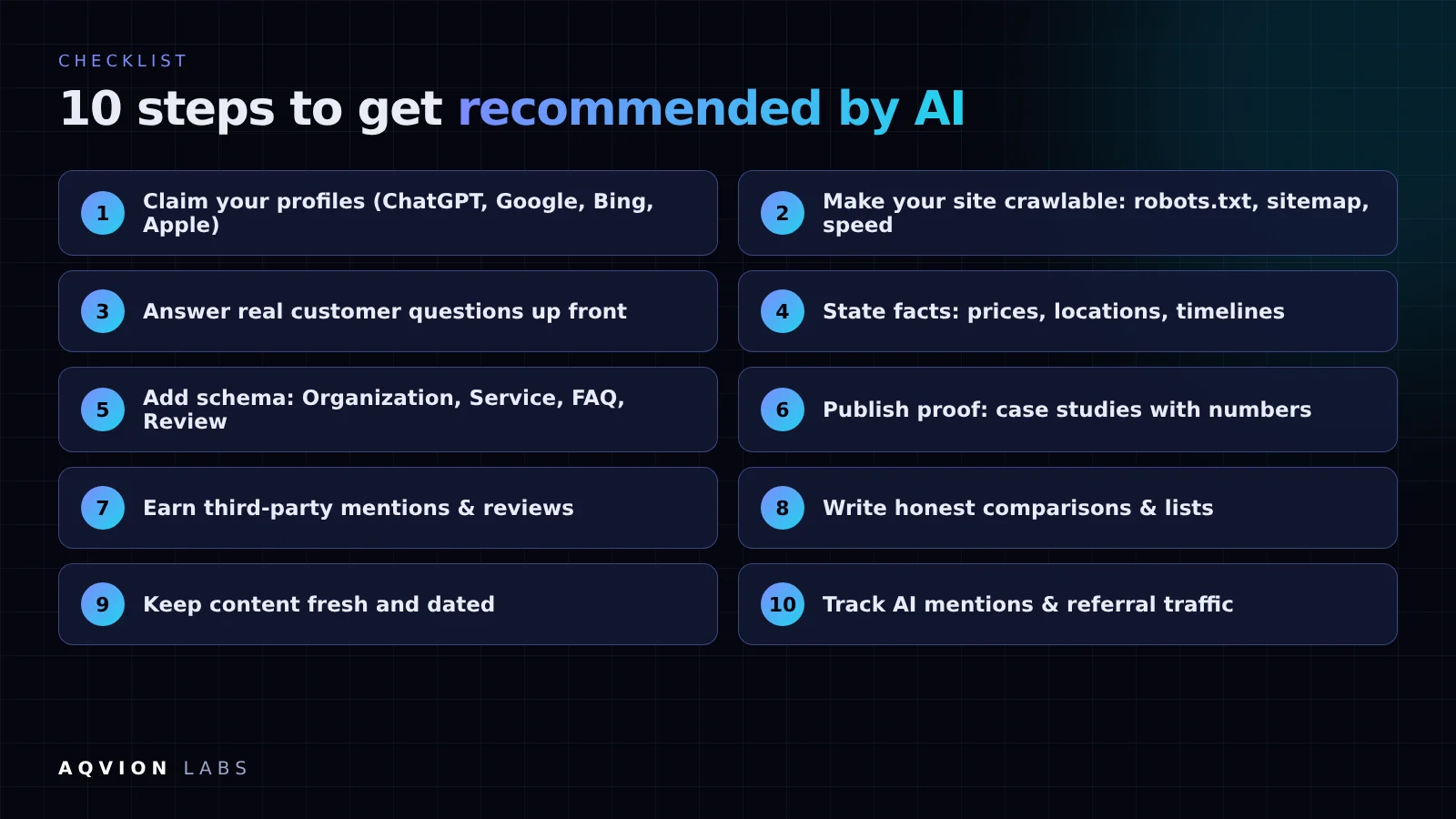
- Claim your profiles. ChatGPT's Business Hub (where available), Google Business Profile, Bing Places, Apple Business Connect, LinkedIn and relevant industry directories. Keep your name, address, phone and services consistent everywhere.
- Make your site crawlable. Allow reputable AI and search crawlers in robots.txt, publish an XML sitemap, keep pages fast, and don't hide key content behind scripts or logins. An
llms.txtfile is optional but helpful. - Answer the real questions. Create pages for the questions customers ask an assistant: what you do, who it's for, how much it costs, how long it takes, and how you compare. Put the direct answer in the first paragraph.
- State facts plainly. Prices or price ranges, locations served, delivery times, guarantees and credentials. AI can't recommend what it can't verify.
- Use structured data. Add schema markup (Organization, LocalBusiness, Product or Service, FAQPage, Article and Review) so machines can read your details reliably.
- Publish proof. Case studies with real numbers, client results, certifications and team expertise. First-hand experience is hard for competitors to copy.
- Earn third-party mentions. Reviews on trusted platforms, guest articles, industry roundups, podcasts, partner pages and local press. Most AI citations come from sites other than your own.
- Write comparison and "best of" content honestly. AI assistants frequently cite comparison articles and lists. Compare options fairly, including when you're not the right fit.
- Keep it fresh. Update key pages and statistics regularly, and show dates. AI systems favor recent content.
- Track your AI visibility. Ask assistants the questions your customers ask, record whether and how you're mentioned, check AI referral traffic in analytics, and use ChatGPT's business analytics if you have access.
What doesn't work
- Keyword stuffing and AI-generated filler: thin content is ignored or treated as low quality.
- Fake reviews or self-made "top 10" lists that only praise you: they undermine trust and can break platform rules.
- Blocking all crawlers: if assistants can't read your site, they rely on whatever others say about you.
- Paying for recommendations: OpenAI states that ads don't change organic recommendations.
How AQVION LABS helps businesses get found by AI
We built our own site, aqvionlabs.com, with AI search in mind: structured data, FAQ markup, clear answers, fast pages, an llms.txt file and crawler-friendly settings. We bring the same approach to client projects:
- AI-ready websites: fast, structured, schema-rich sites through our software engineering and digital product services.
- Content structure for AI answers: service pages, FAQs and case studies written to be understood and cited.
- AI agents for your business: customer-facing assistants and AI systems built on your own product data, with guardrails.
- Measurement: tracking AI mentions and referral traffic alongside classic SEO.
Frequently asked questions
How do I get my business recommended by ChatGPT?
Make your business easy to find, understand and trust. Claim your profiles, including ChatGPT's Business Hub where available. Publish clear answers about your services, prices and location, and add structured data. Earn mentions on trusted third-party sites, and keep information up to date.
What is Businesses in ChatGPT?
It's an OpenAI beta, launched on November 10, 2026, that lets companies claim a verified profile in ChatGPT, update their details, see analytics on how often they're mentioned, and, for eligible US businesses, deploy a Business Agent that answers customer questions.
Can I pay to be recommended by ChatGPT?
Businesses can run ChatGPT ads that point to their Business Agent, but OpenAI says paying doesn't change how often ChatGPT organically recommends a business.
What is the difference between SEO and GEO?
SEO helps you rank in traditional search results. GEO (generative engine optimization) helps your content get used and cited in AI-generated answers. GEO builds on SEO, and adds a stronger focus on direct answers, facts, structure, third-party credibility and freshness.
Does schema markup help with AI search?
Structured data helps machines read your business details, products, FAQs and reviews accurately. It isn't a guarantee of being cited, but it removes ambiguity and supports both search engines and AI assistants.
How long does it take to show up in AI answers?
It varies. Technical fixes and profile claims can take effect within weeks, as pages are recrawled. Building third-party mentions and authority takes months. Track progress by regularly asking AI assistants your customers' questions.
Make your business visible to AI assistants
Want to know how ChatGPT and other assistants describe your business today, and how to improve it? Talk to AQVION LABS about an AI search visibility review and an AI-ready website.
Related reading: AI Agents and AGI: A 2026 Guide for Business · AI Coding Agents and Vibe Coding: A 2026 Guide for Business.
Sources: The Next Web, OpenAI lets businesses claim ChatGPT profiles and launch their own agents (Nov 2026) · Quartz, OpenAI adds verified business profiles and AI agents to ChatGPT · Analyze AI, GEO statistics from 83,670 AI citations. Some statistics come from vendor research; figures are as reported at the time of writing.
Author
AQVION LABS engineers intelligent systems — artificial intelligence, automation, software, data platforms and cloud infrastructure — for organizations building something serious.