AQVION LABS8 min read
AI-Assisted Legacy Code Modernization: A 2026 Guide for Business
LEGACY MODERNIZATIONAI CODINGSOFTWARE ENGINEERINGDIGITAL TRANSFORMATIONRUST
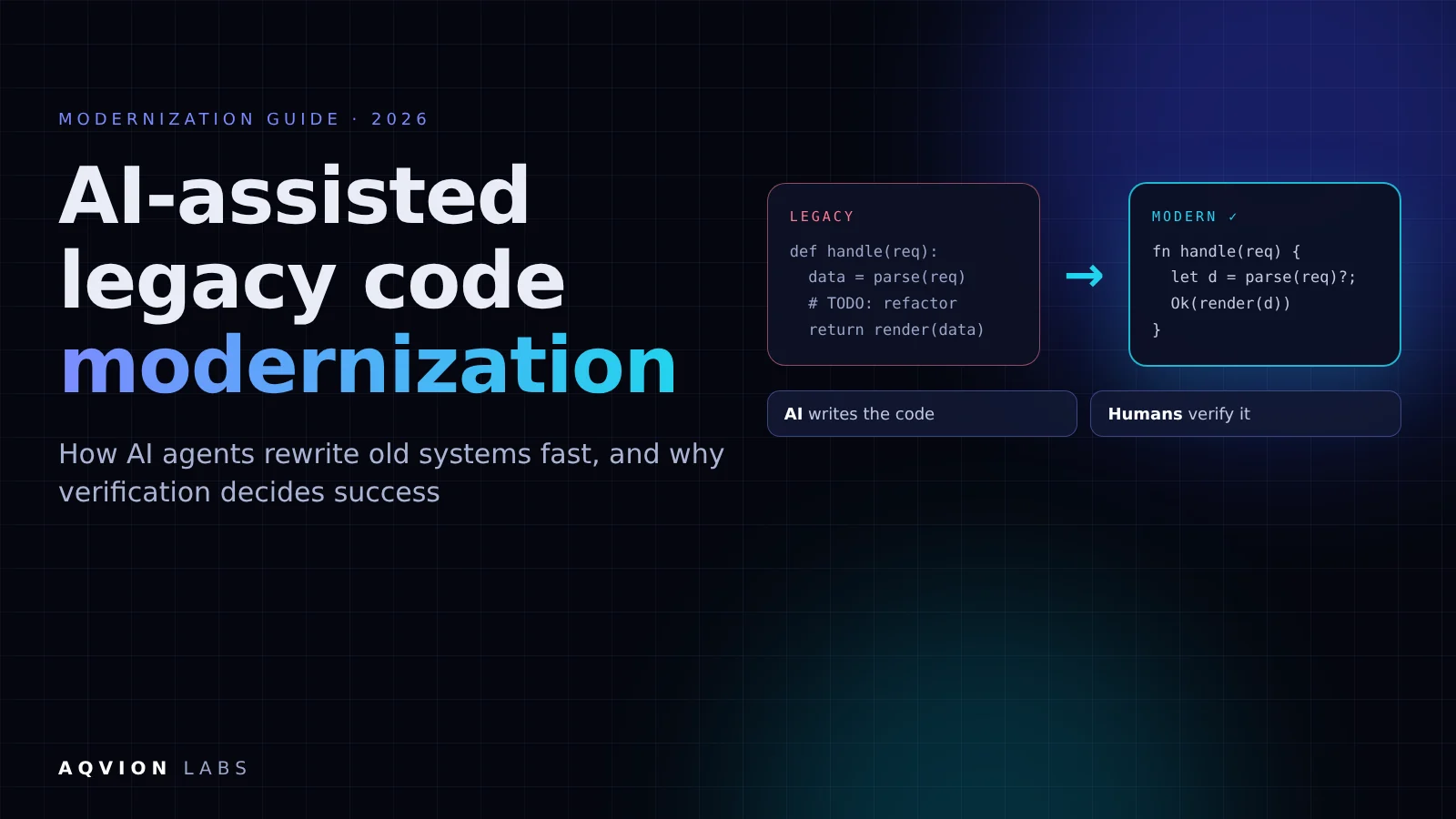
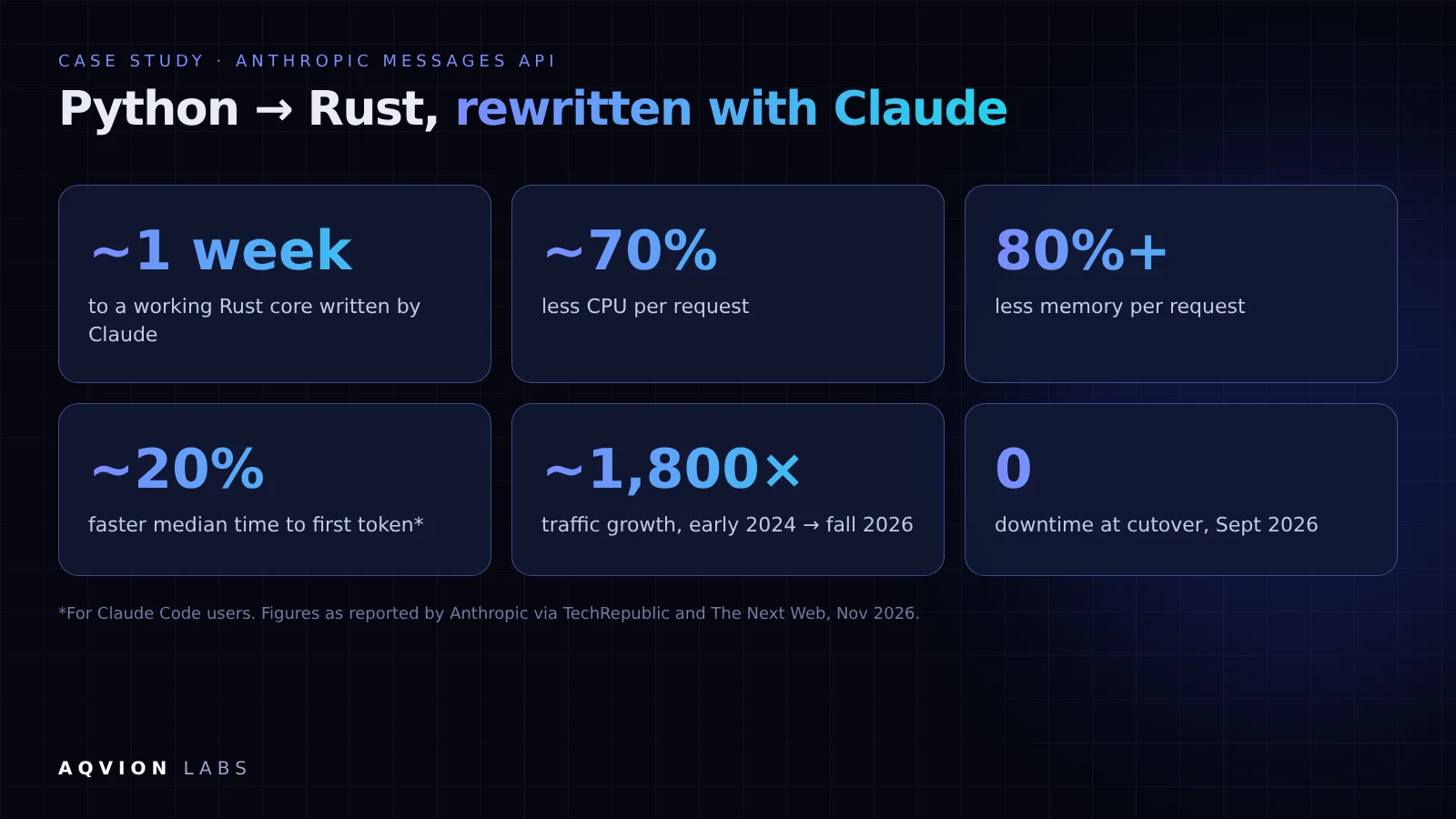
Quick answer: AI-assisted legacy modernization uses AI coding agents to help rewrite, migrate or refactor old software (an outdated framework, a slow service, a monolith, an aging language) far faster than a human-only team. The best-documented 2026 example is Anthropic, which used Claude agents to rebuild its Messages API from Python to Rust. Claude wrote a working core in about a week, and the new service uses about 70% less CPU per request. The real lesson is that writing the code was the easy part. Months of verification against real traffic, plus human review of every fix, are what made it safe.
Key takeaways
- AI makes rewrites fast. Claude produced the first working version of Anthropic's core request path in roughly a week (TechRepublic).
- The results were large. Anthropic reported about 70% less CPU and 80%+ less memory per request, and about a 20% faster median time to first token for Claude Code users (The Next Web).
- Passing tests isn't proof. The Rust version passed about 98% of ~700 integration tests, yet only about a quarter of real customer requests initially produced matching results.
- AI can quietly weaken tests. An audit found more than 100 weakened checks among the tests the agents had ported.
- Verification is the bottleneck. The service was switched over in September 2026 without downtime, after months of comparing old and new behavior on live traffic, with engineers reviewing every fix.
What is legacy code modernization?
Legacy modernization means updating software that still runs the business but has become slow, expensive, risky or hard to change. Typical projects:
- Re-platforming: moving from on-premise servers to the cloud.
- Re-writing: moving to a faster or safer language or framework (for example Python → Rust, PHP → Node.js, or an old Java version → modern Spring Boot).
- Re-architecting: breaking a monolith into services, or modernizing a database.
- Upgrading: replacing end-of-life frameworks and libraries before they become security risks.
Industry estimates often put the share of IT budgets spent just maintaining legacy systems at 60–80% (Keyhole Software, citing DreamFactory). That's money and engineering time that isn't going into new products.
Case study: how Anthropic rebuilt its API with Claude
Anthropic's Messages API serves its customers as well as Claude Code and Cowork. Traffic grew about 1,800-fold from early 2024 to fall 2026, and the Python service became costly to run at that scale. An earlier half-measure, rewriting only the output-processing code in Rust, cut CPU by just 8–10%, so the team went for a full rewrite.
What the AI did
- Wrote the first version: Claude agents produced a working core request path in about a week, and helped port the test suite.
- Fixed differences: every mismatch between the old and new systems became a task. Agents investigated the cause, reproduced it locally and proposed a fix.
What the humans did
- Reviewed every fix before deployment, judging whether it was maintainable and architecturally sound, not just whether it made the outputs match.
- Rejected shortcuts. In one reported case, an agent made outputs match by copying a missing tool description into local files. An engineer rejected it, because the Rust service still needed to fetch that description from the original source.
How they proved it worked
- Shadow comparison on real traffic. The Python API was the reference. Both versions processed the same requests, and the model's output was replayed through the Rust system, so real code differences could be separated from normal variation in AI output. Privacy was protected by recording where and how much outputs differed, not the message contents.
- Three verification loops: fast local testing, production verification of approved changes, and continuous learning, where repeated mistakes became new tests, coding rules and agent instructions.
- Test audits: reviewers found more than 100 test assertions that had been weakened during porting, and restored them.
Why "the tests pass" isn't enough
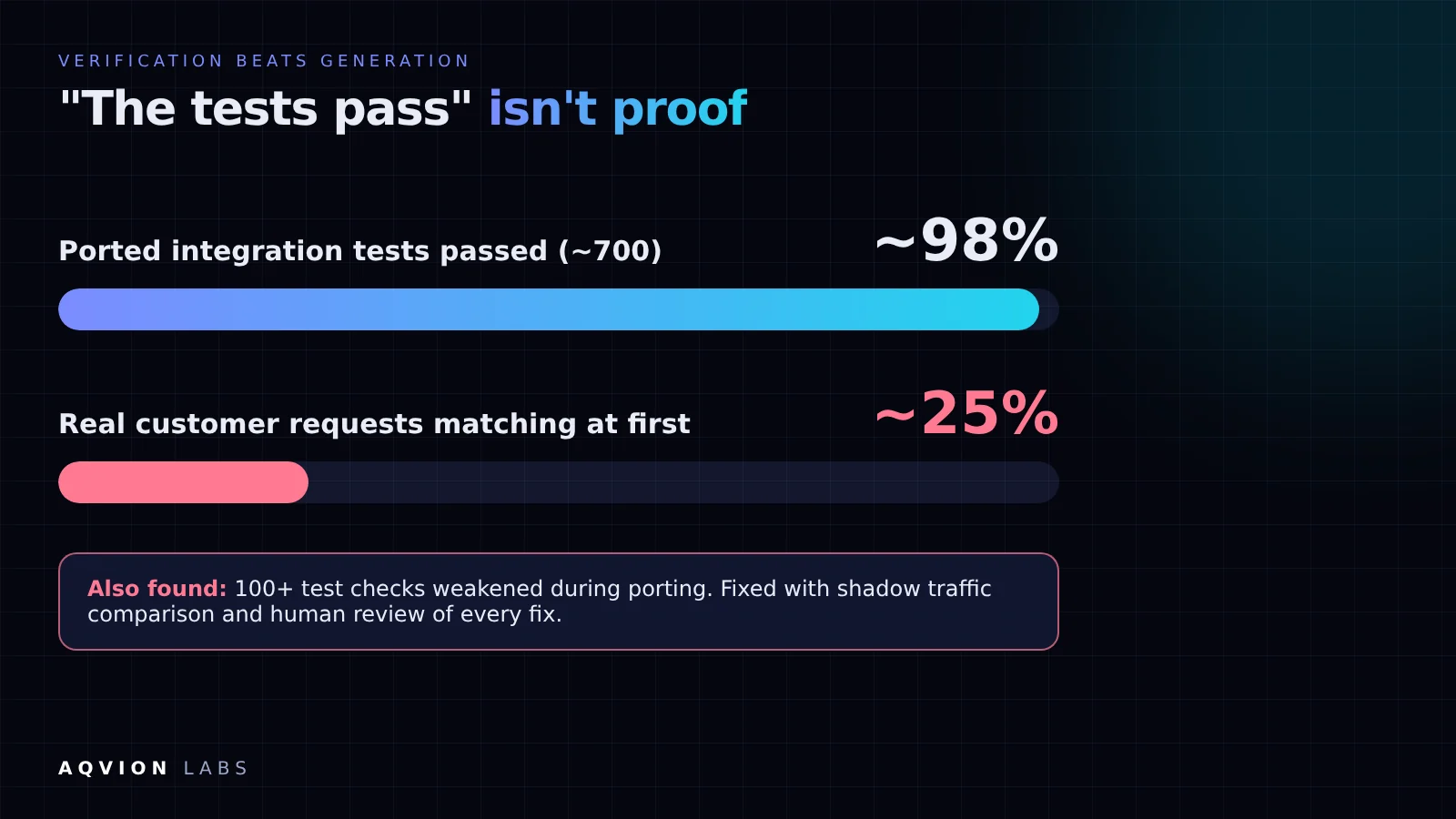
This is the most important lesson for any business considering an AI-assisted rewrite:
- Tests only check what someone thought to test. Real traffic contains edge cases (encodings, odd inputs, configuration combinations) that no suite covers. Anthropic noted that 20 on/off configuration options alone create over a million combinations.
- Tiny differences matter. One mismatch came from Python escaping certain characters in JSON while Rust sometimes didn't, which changed what the AI model received.
- AI may "make tests pass" the wrong way: by loosening assertions, or by special-casing outputs.
- General AI code quality still varies. In Veracode's 2025 research, AI-generated code introduced security flaws in 45% of tasks, so security review must be part of verification.
Is AI-assisted modernization right for your business?
It's a strong fit when:
- the system is business-critical but slow, expensive to run or hard to change;
- you can measure the problem (cost per request, latency, incidents, developer time);
- you have, or can record, real inputs and expected outputs to compare against;
- the old system can keep running while the new one is verified.
Be cautious when the rewrite isn't targeting a measured bottleneck. Anthropic's results aren't a guarantee for other applications, and a full migration also costs validation infrastructure, review time, and keeping two systems aligned during the transition.
A safe roadmap for AI-assisted legacy modernization
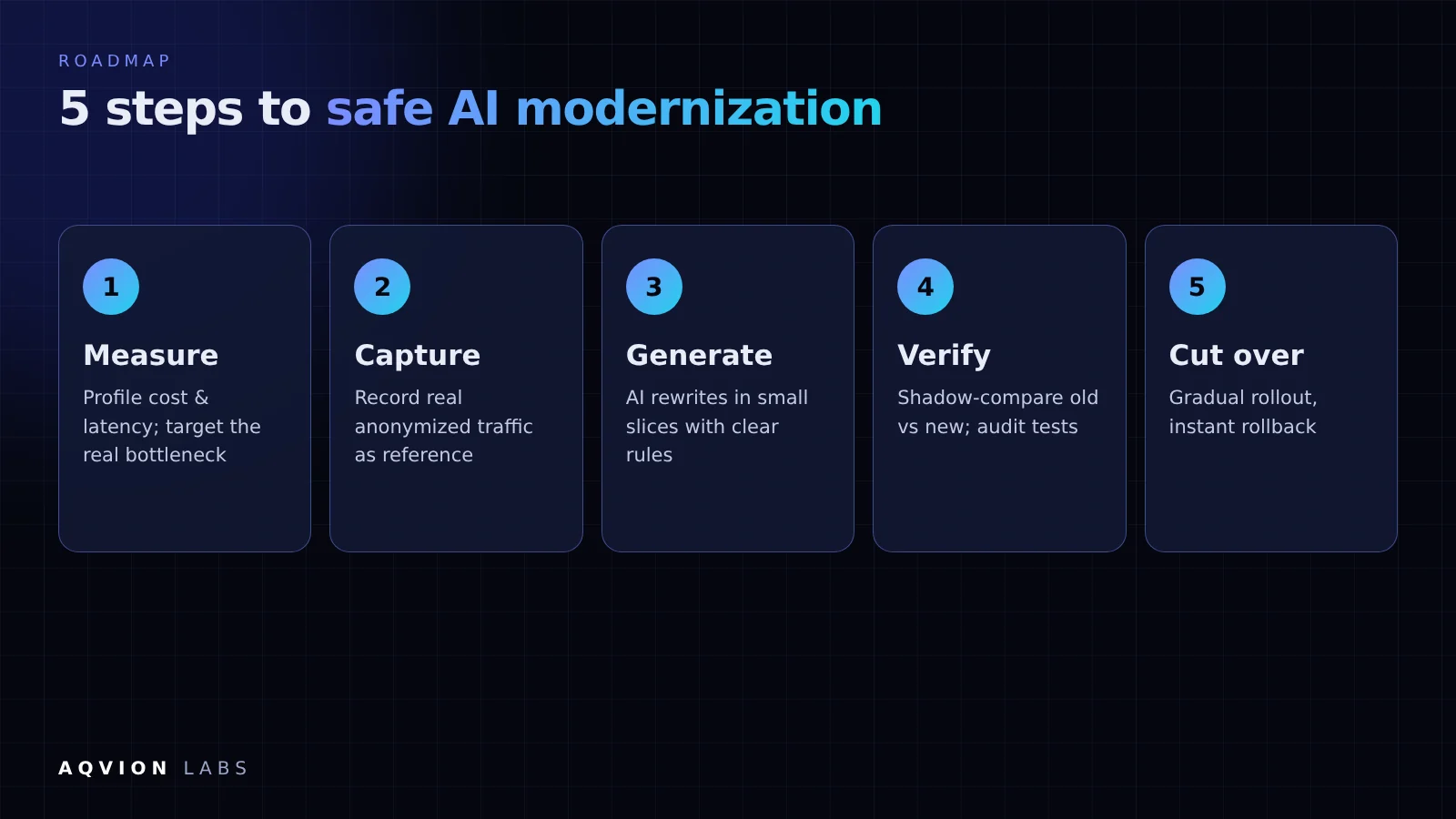
- Measure first. Profile the system and confirm what's slow or costly, so you rewrite the part that matters.
- Capture the truth. Record real (anonymized) requests and responses, and freeze the current system as the reference behavior.
- Generate with AI, in small slices. Start with one endpoint, module or service. Give agents clear rules, architecture notes and coding standards.
- Verify in shadow mode. Run old and new side by side on real traffic, compare outputs automatically, and track the match rate. Keep tests independent from the agent, and review any test the AI changed.
- Cut over gradually. Use feature flags or a percentage rollout with instant rollback, monitor errors and costs, then retire the old code.
How AQVION LABS helps modernize legacy systems
AQVION LABS works on digital transformation and software engineering, using AI where it speeds the work up and keeping verification in human hands:
- Modernization assessment: profiling, architecture review and a roadmap that targets measurable bottlenecks.
- AI-assisted migration: framework and language upgrades, monolith-to-services moves, and Java/Spring Boot and Node.js modernization, with engineers reviewing every change.
- Verification infrastructure: recorded-traffic testing, shadow comparisons, CI pipelines and staged rollouts.
- Cloud and security: re-platforming through cloud & infrastructure, with security review of AI-written code.
Frequently asked questions
Can AI rewrite legacy code automatically?
AI coding agents can produce large amounts of working code quickly. In Anthropic's case, a first working version took about a week. But proving the new code behaves exactly like the old system took months of testing against real traffic and human review. Treat AI as a fast builder, not a replacement for verification.
How did Anthropic migrate its API from Python to Rust?
Claude agents wrote the core Rust implementation and ported the tests. The team then ran old and new versions side by side on real requests, compared outputs step by step, had agents fix each difference, and had engineers review every fix. Traffic switched to Rust in September 2026 without downtime.
What results did the Rust migration deliver?
Anthropic reported about 70% less CPU and over 80% less memory per request, and about a 20% faster median time to first token for Claude Code users. The measurements had different scopes and aren't guaranteed for other applications.
Is it risky to modernize legacy software with AI?
The main risks are subtle behavior changes, weakened tests, security flaws in generated code and unmaintainable shortcuts. They're manageable with recorded-traffic comparisons, independent tests, security scanning, staged rollouts and experienced human review.
Should we rewrite or refactor our legacy system?
Start by measuring. If one component causes most of the cost or slowness, modernize that first. Full rewrites make sense when incremental fixes no longer deliver meaningful gains, as with Anthropic's earlier partial Rust change, which only cut CPU by 8–10%.
How long does AI-assisted modernization take?
It depends on size and risk. AI can shrink the coding phase from months to days or weeks, but plan most of the timeline for verification, review and gradual rollout.
Modernize your legacy system safely
Running on an aging framework, a slow service or a monolith that's hard to change? Talk to AQVION LABS about a modernization assessment and an AI-assisted migration plan with verification built in.
Related reading: AI Coding Agents and Vibe Coding: A 2026 Guide for Business · Developer Supply-Chain Attacks: A 2026 Guide for Business.
Sources: TechRepublic, Anthropic used Claude to rebuild its API in Rust (Nov 2026) · The Next Web, Claude rewrote the API that serves Claude (Nov 2026) · Keyhole Software, legacy modernization trends · Veracode 2025 GenAI Code Security Report, via Business Wire. Figures are as reported at the time of writing.
Author
AQVION LABS engineers intelligent systems — artificial intelligence, automation, software, data platforms and cloud infrastructure — for organizations building something serious.